
A Player's Plea: Why Bethesda's Dialogue Systems Need a Serious Upgrade
Bethesda dialogue systems and RPG conversation depth shine as we explore why compelling, consequential choices are vital for immersive role-play.
Let me tell you, as someone who's spent countless hours living in the worlds Bethesda creates, there's nothing quite like the feeling of a truly great conversation in an RPG. It's the moment you forget you're playing a game and feel like you're genuinely talking to another person, shaping your own story. But lately, I've been feeling a bit... let down. I mean, we're in 2026, and while games like Baldur's Gate 3 have shown us what's possible, Bethesda's dialogue systems still feel like they're stuck in the past. It's not just about having more options; it's about making every single word you choose actually matter. You know what I'm talking about? That feeling of consequence, where a simple choice can ripple out and change everything. That's the magic we're missing.
The Ghost of Fallout 4's Dialogue System
Okay, we gotta talk about the elephant in the room: Fallout 4. Man, that game's dialogue wheel still gives me flashbacks. It was the poster child for how not to do player choice. Remember how it felt? You'd walk up to an NPC, and your options were basically just... vibes.
-
Nice 😊
-
Mean 😠
-
Sarcastic 😏
-
Question ❓
That was it! It wasn't about what you said, but what flavor you wanted your conversation to have. You weren't role-playing a character with depth; you were just picking a mood for the day. It stripped away all the nuance and made every interaction feel like a shallow choose-your-own-adventure book where all the endings are basically the same. Games from way back, like Planescape: Torment, understood this wasn't enough. They gave you dialogue that felt like real tools to interact with a living world, not just buttons to press to advance the plot.
Starfield: A Step Forward, But...
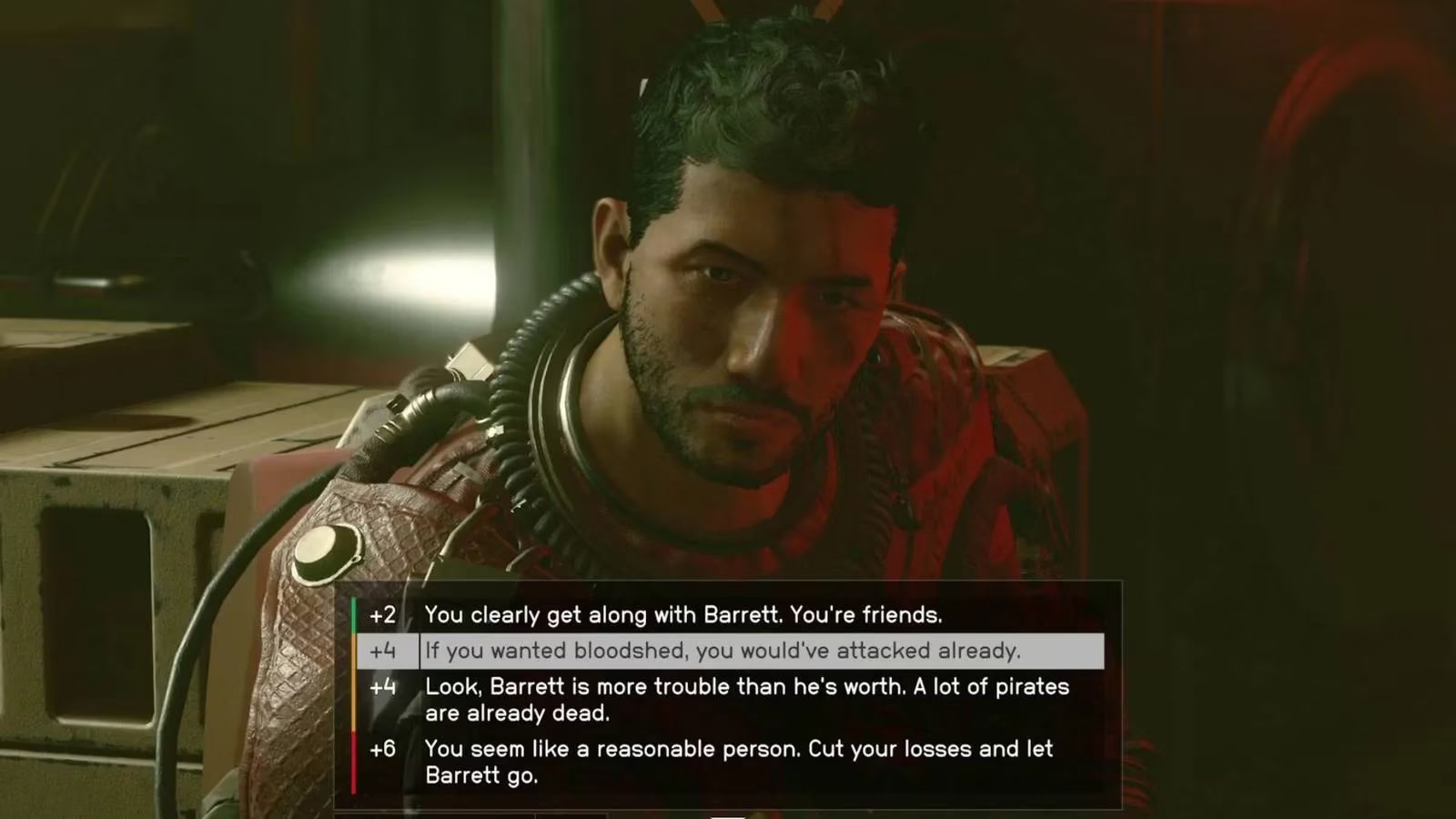
So, when Starfield was announced, I was hopeful. "They've learned their lesson," I thought. And in some ways, they did! Getting rid of the four-option wheel and the voiced protagonist was a good move. It gave us back some imagination—we could decide how our character sounded in our heads again. But... here's the thing. Once you get past that initial relief, you start to notice the same old problems lurking underneath.
The choices you make in Starfield's conversations are still, well, kinda simplistic. They often feel like dead ends. You pick an option, the NPC responds, and then the conversation just... moves on. There's rarely a sense that your words have weight, that they've truly altered the course of events or a character's opinion of you. It's like talking to a very sophisticated chatbot—it can follow the script, but it can't truly react.
Let me put it this way:
| Game | Dialogue Strength | Consequence Level | Role-Play Depth |
|---|---|---|---|
| Fallout 4 | Very Low | Minimal | Shallow |
| Starfield | Low-Medium | Low | Moderate |
| Baldur's Gate 3 | Very High | Very High | Deep |
See the gap? In a modern RPG, we expect our dialogue to be a gameplay mechanic, not just a story delivery system. We want to see:
-
Quests branching in wild, unexpected ways.
-
Characters remembering our insults or kindnesses chapters later.
-
The ability to talk our way out of (or into) a fight we have no business winning.
Starfield's system, bless its heart, just doesn't deliver on that promise consistently. It feels safe. Predictable. And for a game about exploring the infinite unknown, that's a real shame.
The Road Ahead: What We Need from Fallout 5 and TES6
Look, dialogue isn't just filler in a Bethesda game. It's the glue that holds the world together. It's how we connect with characters, learn lore, and define who we are in these massive worlds. If it's going to take up so much of our time, it needs to be worth it.
For Fallout 5 and The Elder Scrolls VI, the bar has been set incredibly high. We're not asking for the moon here (well, maybe a little). We're asking for a system that respects the player's intelligence and commitment. Here’s my wishlist:
-
Meaningful Consequences: Make my words have weight. If I convince a guard to look the other way, that should have a lasting effect, not just work for the next 30 seconds.
-
Character-Specific Reactions: An NPC's personality, faction, and past experiences with me should drastically change how they interpret what I say. A joke to a friend should land differently than a joke to a sworn enemy.
-
Skill-Based Dialogue: This isn't new for Bethesda, but it can be so much deeper. Don't just have a "Persuade" check. Have a "Science" option that lets me solve a problem with logic, a "Barter" option to negotiate a deal, or an "Intimidation" option that actually makes people fear me long-term.
-
Embrace the Weird: Let us have truly bizarre, out-of-left-field conversation paths. The best RPG moments often come from the options you never saw coming.
Bethesda has built worlds we love to get lost in. The exploration, the lore, the sense of scale—it's all there. But the heart of any great RPG is the connection you feel to the people in it, and that connection is forged through conversation. As we look to the future, I just hope they remember that the most important journeys aren't always across vast landscapes, but the ones that happen between two characters, one meaningful choice at a time. The potential is there, just waiting to be unlocked. Let's hope they find the key.
0 Comments