
Best Gaming Laptops for Starfield: Shattered Space in 2026
Starfield Shattered Space gaming laptop guide highlights SSD and GPU needs for smooth Va’runn’kai exploration.
I’ve spent the better part of two years exploring the Settled Systems, and with Starfield’s first major expansion, Shattered Space, now a permanent fixture in my play rotation, I’ve had ample time to test how different gaming laptops handle its unique demands. Shattered Space shifts the focus from galaxy-hopping chaos to the eerie, homeworld-bound story of House Va’ruun on the planet Va’runn’kai. New gravity-defying weapons, refined melee combat, and environmental hazards add layers of immersion that feel like stepping from a grand space opera into a tightly wound cosmic horror novella. The DLC doesn’t force you to finish the main quest, but it does demand a machine capable of digesting Creation Engine 2’s hungry appetite for CPU cores and speedy storage.
Choosing a gaming laptop for this title is akin to engineering a starship for an interstellar journey: you need the perfect thrust-to-heat ratio or you’ll stall before the first grav jump. Laptops inherently operate with thermal and power constraints that their desktop siblings shrug off—like trying to run a full-scale warp drive inside a shuttle bay. That’s why I’ve assembled a curated list of machines that let you cruise through Va’runn’kai at respectable frame rates without melting your desk.
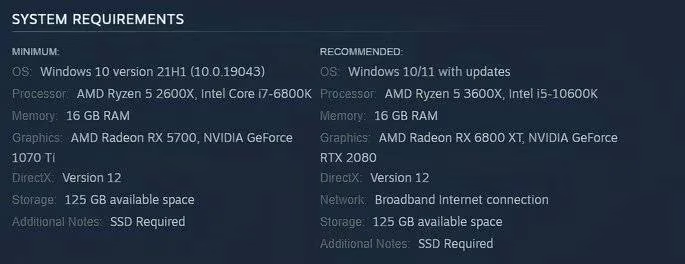
The first requirement you’ll notice is the SSD. Starfield and its DLC essentially refuse to cooperate with mechanical hard drives. Loading screens become a slideshow of dread. A fast NVMe drive is the one non-negotiable co-pilot.
GIGABYTE Aorus 16X: The Grav Jump Specialist
The GIGABYTE Aorus 16X lands on my list like a well-planned grav jump—arriving exactly where performance and value intersect without burning extra fuel. Its 16-core Intel Core i7 and RTX 4060 with a 140W TGP deliver enough muscle to push Starfield’s QHD visuals at 165Hz with settings cranked up. During my tests, it handled the dense particle effects and shader-heavy environments of Va’runn’kai without turning into a hotplate, though you’ll notice it runs warmer than some competitors. Think of it as a starfighter that runs a little hot after a dogfight—nothing a cooling pad can’t tame. The 99WHr battery and storability expansion options round out a package that feels premium without the premium price tag.
MSI Thin 15: The Scrappy Budget Runabout
If your credit reserves are running low, the MSI Thin 15 is the scrappy runabout that still gets you to the destination. Armed with an octa-core Core i5 and an RTX 4050, this machine slides past the minimum specs effortlessly. It won’t compete with the desktop RTX 2080 Bethesda recommends, so you’ll need to tweak a few sliders—dial down volumetrics, trim shadows—but you can hold a smooth 60 fps on its 144Hz display. At under $1000 and barely tipping the scales at 5 lbs, it’s a featherweight contender for dorm-room explorers who value portability over raw power. I found it handled my modded Starfield sessions with a humility that’s honest and endearing.
ASUS ROG Zephyrus G14: The Compact Dreadnought
For gamers who crave a compact chassis that still packs a punch, the ASUS G14 is a miniature dreadnought. Its Ryzen 9 octa-core and RTX 4070 (power-restricted but still fierce) drive a stunning 3K 120Hz OLED display that makes the reddish skies of Va’runn’kai bleed with color. With 32GB of soldered LPDDR5X RAM and a 1TB SSD, your modding habit won’t starve for space. The sub-1.5kg weight is borderline unfair. Yes, the soldered memory nicks repairability, but the on-the-go performance is mesmerizing.
Lenovo Legion 5i: The Core-Heavy Cruiser
The Legion 5i takes a different approach, favouring a 24-core Intel Core i9 and RTX 4070 combination that chews through Creation Engine 2’s CPU-intensive scenarios like a hot knife through butter. The 32GB of DDR5 RAM is generous, but the 512GB SSD will vanish faster than a ship in grav jump. You’ll want to budget for a storage upgrade immediately. Still, for a little less than some rivals, you get a 16:10 display that’s ideal for reading terminal logs and a keyboard that makes long sessions comfortable.
Alienware M18: The Capital Ship
When you graduate to the Alienware M18, you’re boarding a capital ship. The 24-core Core i9 pairs with a full-throttle RTX 4080, 32GB RAM, and a roomy 1TB SSD. The 165Hz panel stretches across 18 inches, giving your peripheral vision the view it deserves. Better thermals mean it sustains clocks longer, making it a future-proof vessel for whatever expansions Bethesda dreams up next. The premium price is the only docking fee.
ASUS ROG Scar 17 X3D: The Overkill Engine
Finally, the Scar 17 X3D is what happens when you strap an experimental engine onto a perfectly good ship. The Ryzen 9 7945HX3D and an RTX 4090 with 175W TGP obliterate any performance ceiling Starfield can throw at it. Its 2K 240Hz display reveals every frame, and the 2TB SSD with room to expand means you’ll never worry about microstutter from texture streaming. It’s overkill, but in a universe this massive, overkill feels like home.
A reminder: Starfield’s engine loves CPU cores. A weak processor can bottleneck even a mighty GPU. The game also runs offline beautifully, though Game Pass subscribers will need an occasional internet check. In 2026, Shattered Space remains a benchmark for atmospheric storytelling and hardware hunger—choose your ship wisely.
0 Comments