
Bethesda's Biggest Worlds: From Cozy Wastelands to Infinite Tamriel
Discover the expansive realms of Bethesda Game Studios, a legendary developer known for crafting vast open worlds that immerse players in unforgettable digital adventures. From the intimate Commonwealth of Fallout 4 to the sprawling, hand-crafted landscapes of Skyrim and Oblivion, each game offers a unique scale of exploration and storytelling.
For decades, Bethesda Game Studios has been synonymous with a philosophy of 'go big or go home,' crafting digital realms so vast and detailed they could house a Pixar film's worth of quirky bugs and eccentric characters. As of 2026, the studio's portfolio is a fascinating study in scale, ranging from the intimate ruins of post-apocalyptic Boston to mind-bogglingly infinite procedurally generated continents. While the density of stories and secrets often matters more than raw square mileage, there's an undeniable thrill in knowing just how much digital real estate you can get lost in. So, strap on your power armor or sharpen your enchanted blade, as we traverse the viewable, explorable, and sometimes sprint-free expanses of Bethesda's legendary open worlds, ranked by sheer size.
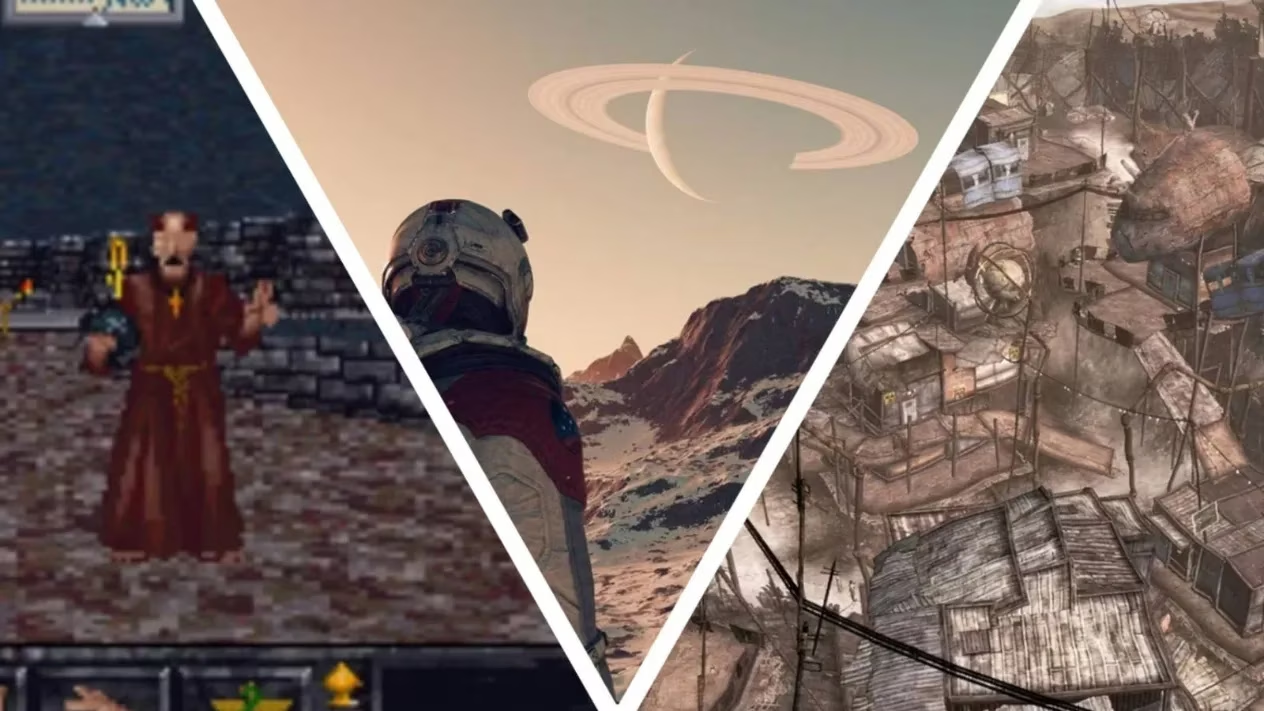
Kicking off our list is the surprisingly cozy Commonwealth of Fallout 4. At a 'mere' 10.36 km², it's the smallest of the modern Bethesda worlds. Don't let the compact size fool you, though. This post-apocalyptic slice of Boston and Massachusetts packs a punch with over 27 hours of main story, wild side quests, and the endlessly addictive (or infuriating) settlement building system. It's proof that sometimes, a smaller, more curated sandbox can be just as engaging as a sprawling one. Just mind the molerats.
Next, we travel to the weird and wonderful island of Vvardenfell in The Elder Scrolls III: Morrowind. Clocking in at 16 km², it's technically the smallest main-series Elder Scrolls map. Yet, ask any fan, and they'll swear it feels larger than life. Why? The secret ingredient is the lack of convenient fast travel. You're not just clicking on a map icon; you're haggling for a Silt Strider ride, booking passage on a rickety boat, or simply walking and discovering the bizarre, mushroom-filled landscape for yourself. Its density of unique culture, complex systems, and sheer alien atmosphere makes every square kilometer count double.
Ah, Skyrim. The land of Nordic ruins, sweet rolls, and incessant dragon attacks. The fifth Elder Scrolls adventure offers a respectable 37 km² of snowy peaks, autumnal forests, and bustling towns. While not the largest in the series, its size is a masterclass in handcrafted design. Unlike some of its predecessors, much of Skyrim was built by hand, leading to a world that feels intentionally designed around every Draugr-filled tomb and hidden quest. You can traverse it on foot, by stolen horse, or even by shouting at the clouds until a dragon reluctantly gives you a lift. It's compact enough to feel familiar, yet vast enough to keep players discovering new things over a decade later.
Slightly edging out its frosty successor is the recently remastered realm of Cyrodiil in The Elder Scrolls IV: Oblivion. With 41 km² of playing area, it holds the title for the largest hand-crafted world in the Elder Scrolls pantheon. It's a lush, vibrant world where NPCs actually seem to live their lives thanks to the pioneering Radiant AI. You can follow a guard on his patrol, watch a shopkeeper close up for the night, or just enjoy the view of the Imperial City's White-Gold Tower from a hilltop—all while on a quest to stop a cult from opening gates to a hellish dimension. Standard Tuesday stuff.
Now, let's talk nuclear wastelands. Fallout 3, Bethesda's first crack at the franchise, presents a desolate 41.4 km² of Capital Wasteland. Set in the ruins of Washington D.C., it's a world of chilling beauty and decay. There's just one catch: you can't run. That's right, for the entirety of this 40+ square kilometer trek, your primary mode of transport is a determined walk. It's immersive, it's atmospheric, and it really, really makes you appreciate the fast-travel system once you unlock it. The size feels monumental when you're pacing past every ruined monument and super mutant camp.
Bethesda's multiplayer experiment, Fallout 76, takes the Fallout crown for map size—at least at launch. The base map of Appalachia measures 41.99 km², a whole 0.59 km² bigger than Fallout 3's Capital Wasteland. Not exactly a quantum leap, but sizeable nonetheless! Of course, by 2026, years of steady updates have expanded this world far beyond its original borders, adding regions inspired by Shenandoah and New Jersey. It's a living world that has grown alongside its community, proving that in a multiplayer setting, a big map needs constant new frontiers.
And now, we enter the realm of the absurdly large. The Elder Scrolls II: Daggerfall is legendary for its scale. We're talking about 161,600 km² of procedurally generated High Rock and Hammerfell. To put that in perspective, that's roughly the size of England, Scotland, Wales, and Northern Ireland combined. It features around 15,000 towns, cities, and dungeons. The main quest? Almost an afterthought in a world this massive, where you can buy houses, join guilds, and craft your own spells for hundreds of hours without ever touching the main story. It's a monument to the ambition—and the limitations—of 1990s procedural generation.
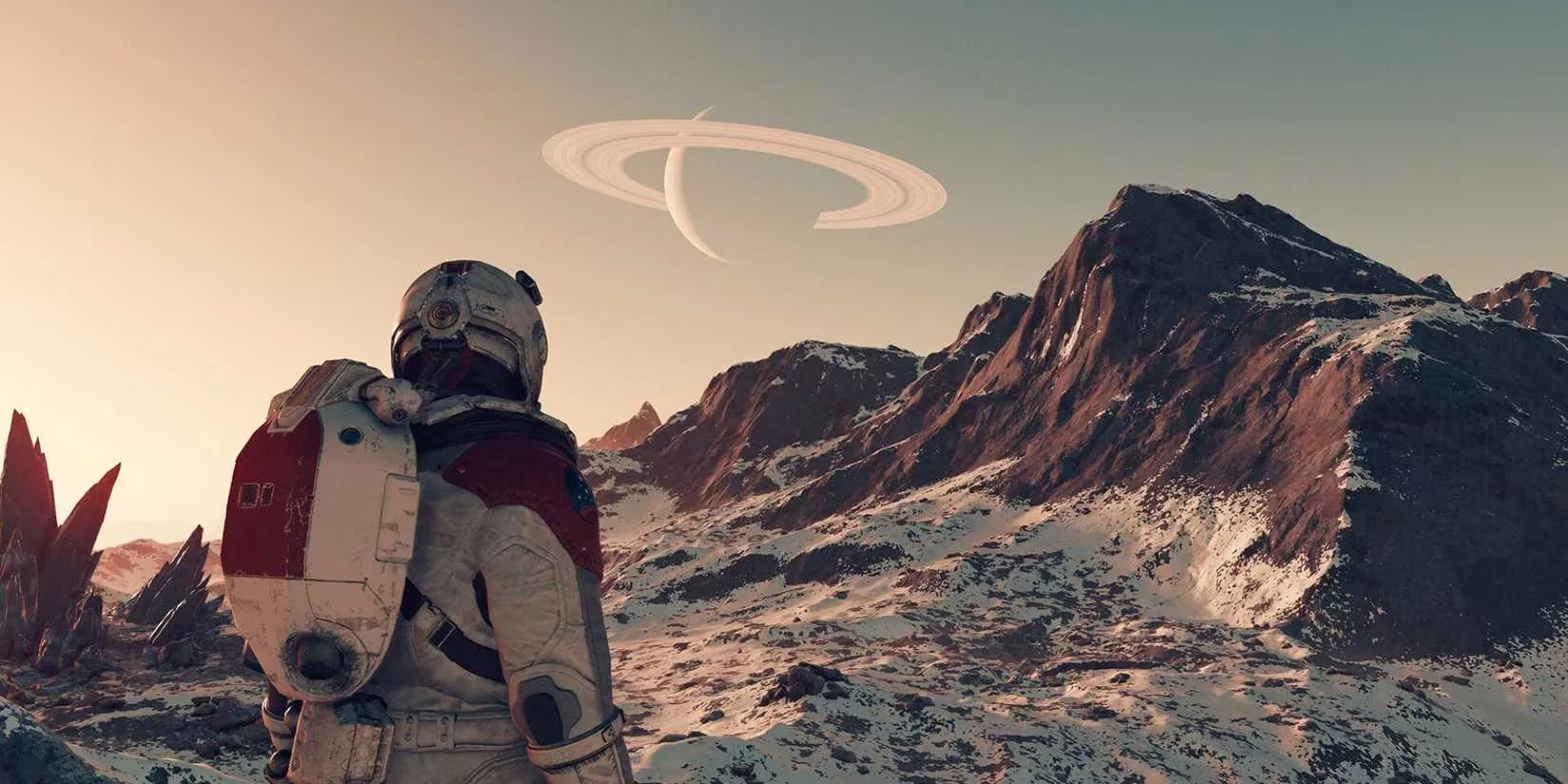
Bethesda's latest original universe, Starfield, takes the concept of a 'big map' and launches it into the stratosphere. Literally. With over 2,589,988 km² of explorable surface area across more than 1,000 planets and moons, it's a spacefaring epic of unimaginable scale. This is only possible through sophisticated procedural generation, creating unique biomes and landscapes for each celestial body you visit. Yet, nestled within this near-infinite cosmos are handcrafted gems like New Atlantis, Bethesda's largest single city to date. It's a universe of contrasts: the lonely, generated plains of a distant moon versus the bustling, intentionally designed corridors of a spaceport.
Finally, we reach the champion, the behemoth, the grandfather of them all: The Elder Scrolls: Arena. The game that started it all isn't just big; it's technically infinite. Due to its pioneering use of procedural generation, the game could theoretically generate land forever. Practical limitations of mid-90s computing, however, cap it at a 'mere' 9,000,000 km²—roughly the size of the entire continent of Europe. This encompasses the entirety of Tamriel, a feat no other game in the series has attempted. It's a raw, ambitious, and endlessly fascinating prototype of the epic scale Bethesda would continue to chase for decades. You can fight monsters, sleep in inns, and uncover conspiracies across a continent that feels truly, bewilderingly endless.
| Game | World Size (km²) | Key Feature |
|---|---|---|
| Fallout 4 | 10.36 | Dense, handcrafted Boston wasteland |
| Morrowind | 16 | No easy fast travel; feels huge |
| Skyrim | 37 | Iconic, handcrafted Nordic realm |
| Oblivion | 41 | Largest hand-crafted TES world |
| Fallout 3 | 41.4 | No sprinting! Atmospheric Capital Wasteland |
| Fallout 76 | 41.99+ | Growing multiplayer Appalachia |
| Daggerfall | 161,600 | Monumental procedural generation |
| Starfield | 2,589,988+ | A thousand planets to explore |
| Arena | ~9,000,000 | The (theoretically) infinite original |
In the end, Bethesda's worlds teach us that size is just a number. 🤔 A smaller, meticulously crafted map like Skyrim can leave a more lasting impression than an infinite, generated one. Yet, the sheer audacity of games like Daggerfall, Starfield, and Arena captures a specific kind of magic—the promise of a frontier so vast you can never truly see it all. It's a promise that, bugs and all, keeps players coming back for just one more quest, one more planet, one more forgotten dungeon in a world that feels truly alive. Or at least, alive with the cheerful chirping of radroaches and the distant roar of dragons.
0 Comments