
How Starfield’s Ship Builder Almost Relied on Outpost Resources Instead of Credits
Starfield's ship builder was originally tied to a deep outpost manufacturing loop, but Bethesda cut it to avoid feature creep.
So I was digging into some older interviews recently, and a conversation with former Bethesda designer Bruce Nesmith completely reframed how I look at Starfield’s ship builder. We all know the ship builder is easily one of the best parts of the game—building wild, custom starships out of modular parts you grab from various ports. But it turns out that wasn’t always the plan. Originally, the whole system was meant to be deeply tied to outposts, resources, and interstellar manufacturing, not just throwing credits at a vendor. And honestly? I can’t stop thinking about what could have been.
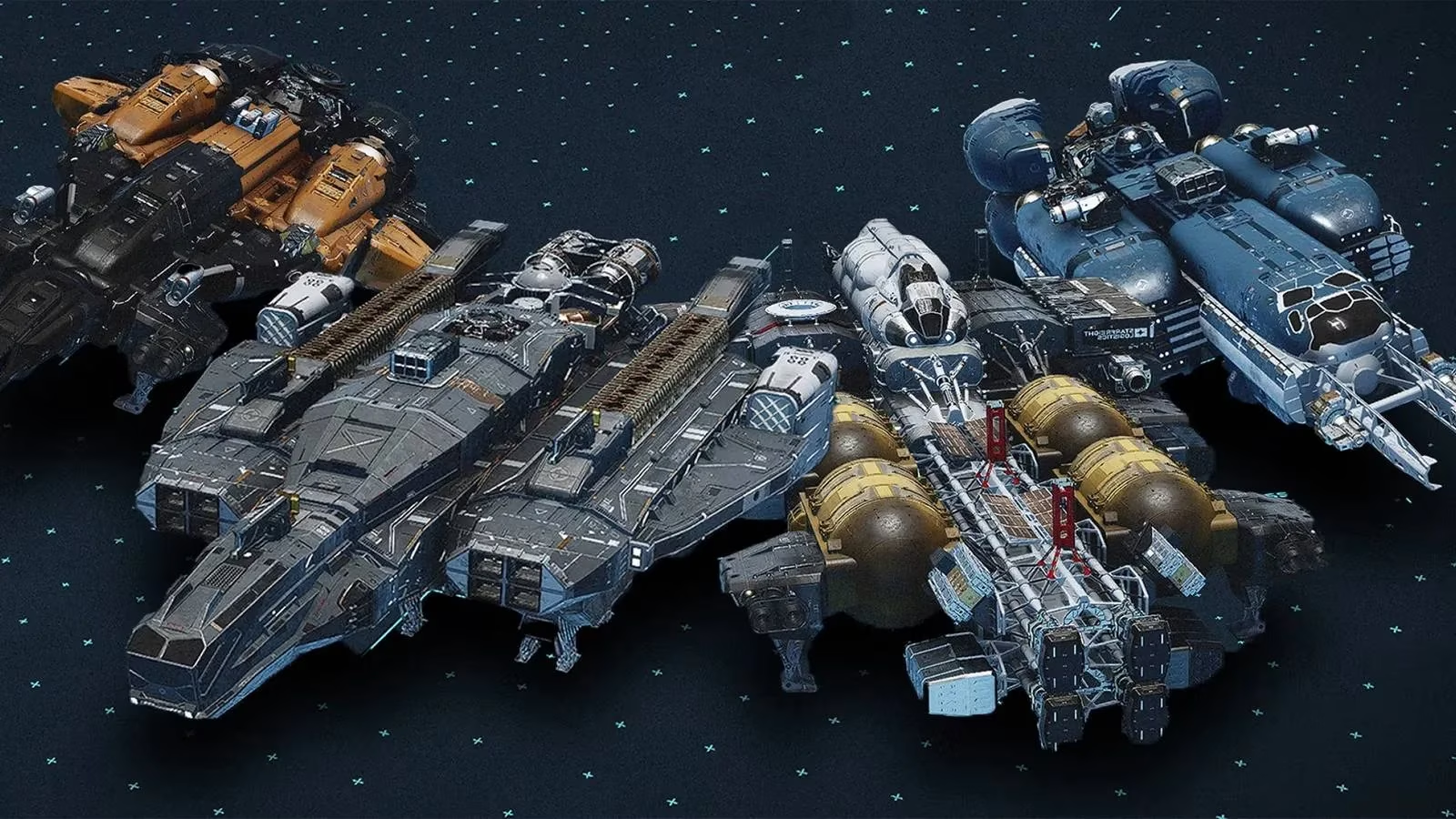
Back when Starfield was still in the oven, the dev team had this grand vision. Instead of walking into a ship services office and buying a reactor or landing gear with your hard-earned credits, you’d have to actually build the parts yourself. The loop would’ve looked something like this: first, you set up mining outposts to extract raw materials—iron, aluminum, exotic gases, you name it. Then, those materials would get shipped off to a factory outpost on another planet. That factory would churn out specific ship modules. Only after that whole chain could you assemble your new vessel. Nesmith described it as “a complete set of being able to mine materials, send them to a factory on another world that would then build space-ship modules that you could build your own spaceships with.” That’s a massive departure from what we got.
It wasn’t just a side gimmick either. The team wanted to build the entire in-game economy around this manufacturing loop. Every ship part, and probably a lot of other gear, would have flowed from the player’s industrial empire. In theory, it sounds amazing—a true sandbox where your spaceships are the literal product of your colonisation efforts. But as Nesmith admitted, the whole idea fell victim to feature creep. The more they developed it, the more it tangled up other systems and slowed down progress on the core game. Eventually, they had to cut it.
I’ll be blunt: I think Bethesda made the right call here. As much as I adore complex logistics games, Starfield’s resource gathering can be a real chore. Rare minerals are locked behind scanning RNG and tedious outpost management. If every new engine or cockpit forced me to babysit cargo links between three planets, I’d probably never build more than one ship. The current system—pay credits, snap parts together, fly off—just works. It’s immediate, satisfying, and lets creativity run wild. That convenience is a huge reason the ship builder became the community’s favourite toy. Players have recreated everything from the Millennium Falcon to Warhammer battle barges, and they did it without ever touching an outpost.
Of course, you can still engage with outposts if you want. They’re optional, just like the ship builder isn’t strictly mandatory to beat the main story. But the fact that both systems live separately means you never feel forced into a playstyle you might hate. If the original design had shipped, a lot of players would’ve bounced off ship building entirely, grumbling about being pushed into a factory sim. The modular, credit-based builder lets you dip in for an hour to tweak your ride, then hop back to exploring. It respects your time, weirdly enough for a Bethesda RPG.
Now, fast forward to 2026. We’ve had the Shattered Space expansion, plus a year of updates and modding breakthroughs. And guess what? The original ship-building concept hasn’t really come back, even through mods. A few ambitious creators tried to patch together a resource-based economy, but the challenge is staggering. How do you make establishing a network of interstellar factories feel engaging rather than a spreadsheet nightmare? Without dedicated UI and gameplay support from Bethesda, it’s a tough ask. The mod scene keeps thriving, but it leans more on adding new ship parts, habs, and visual customisation, not overhauling the entire crafting loop. And honestly, that’s telling me something: the current system is so flexible and fun that even modders don’t feel the itch to radically rewrite it.
Looking back, I appreciate the ambition of that cut system. It’s the kind of crazy, interconnected design that makes Bethesda games so unique when it works. But sometimes, you’ve got to know when to simplify. Starfield’s ship builder became a breakout star precisely because you can just buy your way to a dream starship. No cargo links, no factory downtime, no despair when your helium-3 supply chain fails. That doesn’t mean the idea is dead forever—maybe we’ll see a game that does it right one day. For now, I’m grateful I can snap together a battlecruiser in ten minutes and go shoot pirates without worrying about my outpost’s aluminium output.
What do you think? Would you have preferred a deep resource-to-ship pipeline, or are you happy with the credit-based freedom? For me, the answer’s clear every time I see my latest abomination lift off from New Atlantis.
0 Comments