
Starfield's Cosmic Crossroads: Why Multiplayer Could Be Its Constellation of Hope in 2026
Starfield and The Elder Scrolls 6 captivate the gaming cosmos, yet Starfield yearns for multiplayer to truly ignite its universe anew.
The stardust has settled, and here I am, a lone traveler gazing at the celestial map of 2026, where Starfield drifts like a magnificent yet solitary comet. While the gravitational pull of The Elder Scrolls 6 grows ever stronger in the gaming cosmos, my beloved spacefaring epic feels like a breathtaking nebula observed through a single telescope—full of wonder, but aching for shared discovery. I've charted its thousand planets and walked its silent corridors, and my heart holds a conviction as vast as the Settled Systems: for this universe to truly live, it must learn to echo with more than one set of footsteps.
“But Must Every Sky Have Constellations of Other Players?”
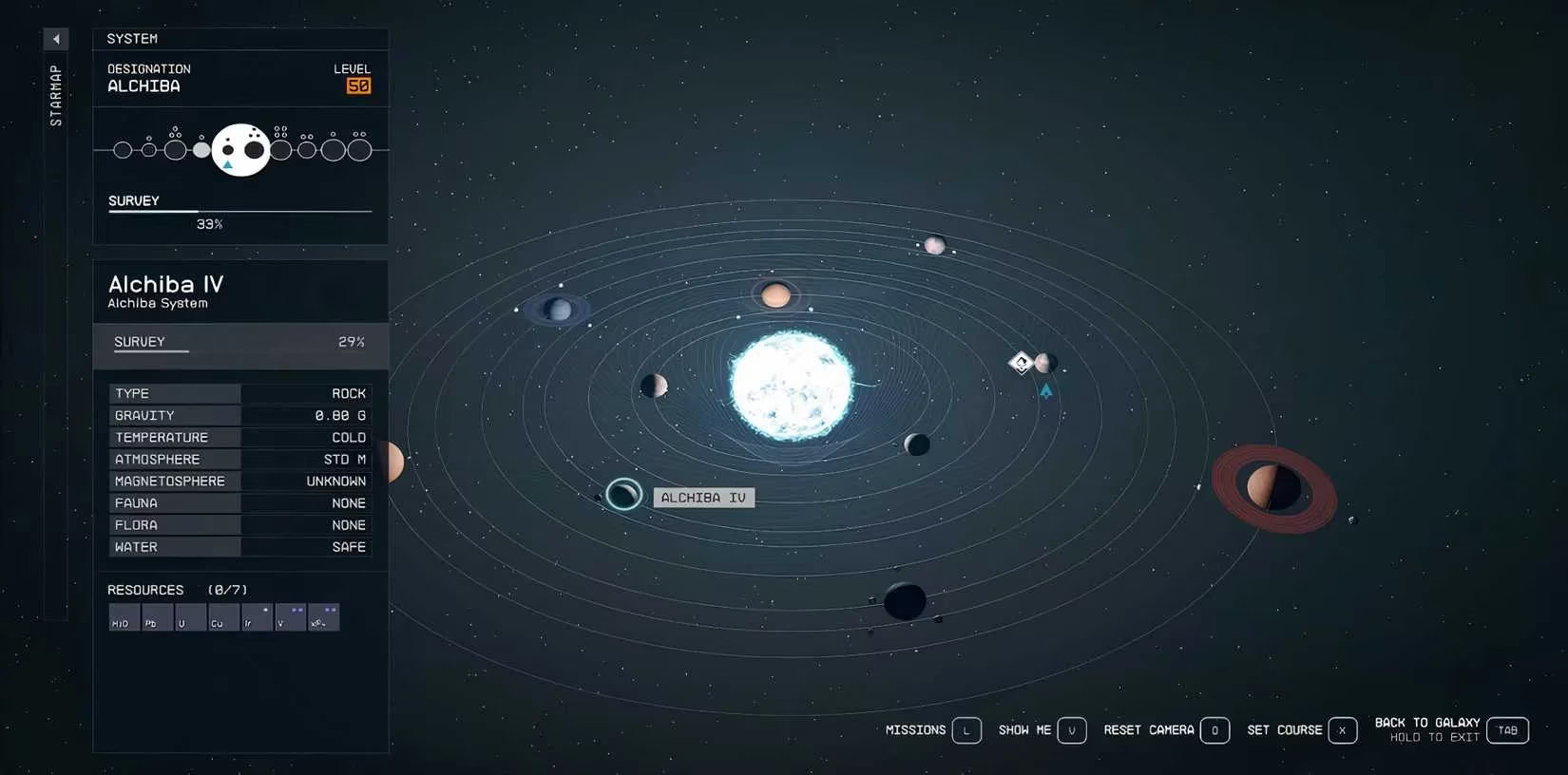
Let me be clear—I am a pilgrim at the altar of solitary journeys. I believe some experiences are like rare, ancient manuscripts best read alone in a quiet study, their magic woven into personal, uninterrupted contemplation. Games like The Outer Wilds or Red Dead Redemption 2 are testaments to this. My love for Starfield is not born from a desire to turn it into a bustling spaceport casino. Yet, watching its player count dwindle has been like witnessing a star slowly transitioning to a red giant—a magnificent, inevitable dimming. Continued story DLCs and mods are the steady solar winds that keep it glowing, but I fear they are not enough to reignite its core. Multiplayer isn't the only path, but it could be the most dynamic reactor to power a second golden age.
Learning from Bethesda's Celestial Cartography: Successes and Black Holes
Bethesda’s own galactic history provides the perfect star charts for this journey. We have two distinct constellations:
| Title | Development | Core Approach | Launch & Legacy |
|---|---|---|---|
| Fallout 76 | Bethesda Game Studios | Single-player RPG "sprinkled" with MMO | Rocky start, now a stable, living world |
| The Elder Scrolls Online | Zenimax Online Studios | Full MMO "sprinkled" with TES lore | Rough reception, now a thriving universe |
Both are now stable orbits in the gaming firmament, but their initial trajectories were fraught with gravitational anomalies. The lesson is not to avoid multiplayer, but to navigate the asteroid field with a better scanner. Starfield cannot afford another Fallout 76-style launch event; its reputation is already a fragile moonbase after a meteor shower. A failed foray into multiplayer now would be like a warp drive misfiring directly into a black hole—catastrophic and final for the IP's future.
Two Viable Orbits: The Subtle Ghost or the Bold Constellation
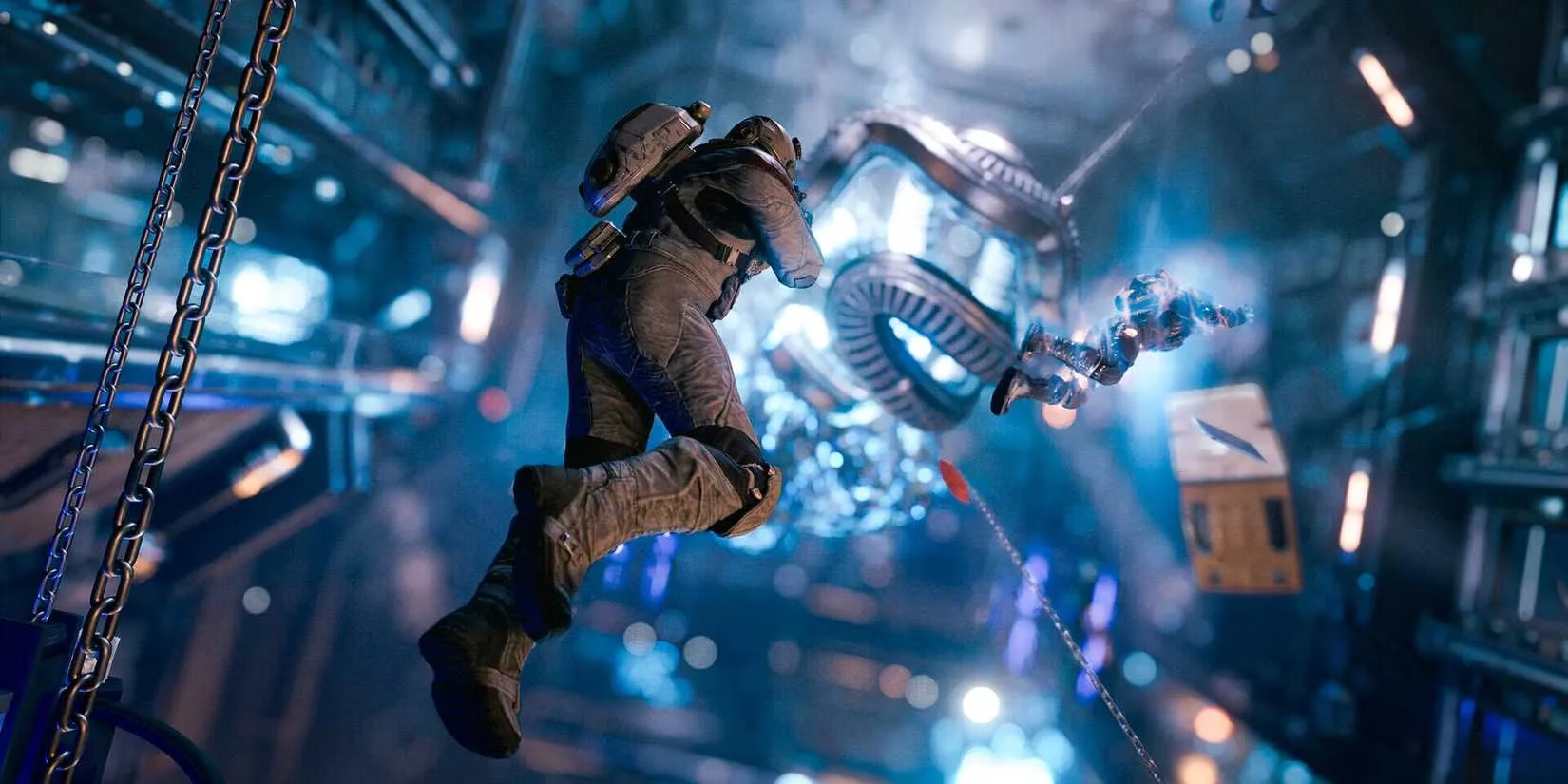
I see two viable cosmic paths, each with its own promise:
-
The "Death Stranding" Orbit: A Universe of Ghosts. This would be a soft, integrated online layer. Imagine:
-
Building an outpost and later finding a crate of rare resources left by another player's ghost data, like finding a message in a bottle washed up on a lonely shore.
-
Seeing faint, shimmering echoes of other captains who completed a difficult dogfight in a particular asteroid belt, their success subtly boosting your ship's scanner range in that area.
-
Community goals where combined resource contributions across all players slowly construct a new space station in a remote system, a monument to collective, silent effort.
The universe feels alive and interconnected without ever forcing a direct, jarring encounter. It would be like the universe itself gained a faint, benevolent consciousness shaped by all who explore it.
-
-
The "Zenimax" Orbit: A New Galactic Core. The more ambitious path. Bethesda Game Studios hands the MMO framework to Zenimax Online Studios for a separate, full-scale Starfield Online. This wouldn't replace the single-player game but exist alongside it, a parallel universe. Let the main game remain my personal, pristine star chart, while the MMO becomes a vibrant, player-driven frontier. This approach contains the risk, protecting the original's integrity.
The Final Approach Vector: No Half-Measures in the Void
The worst possible outcome is a middling, confused attempt—a multiplayer mode bolted on like a mismatched engine module that destabilizes the whole ship. Bethesda must commit. Either weave online elements into the fabric of the existing universe with the delicate care of a scientist assembling a quantum computer, or launch a dedicated, full-blooded MMO with clear separation and purpose.
As I sit in my virtual cockpit in 2026, the potential I see for Starfield is as infinite as the cosmos it depicts. The Shattered Space DLC was a compelling new chapter, but it was another story told in the same quiet room. The modding community is a galaxy of creativity, but it's a private universe for each individual. To make Starfield the lasting, iconic third pillar Bethesda dreamed of, it must evolve. It must find a way to make its silence feel like a pregnant pause before a chorus, not the eternal quiet of a derelict ship. Adding a multiplayer dimension—whether as a whisper or a shout—isn't about abandoning its soul; it's about giving that soul a way to resonate across the vast, lonely dark, turning a single star's light into a constellation that guides others home. The risk is a supernova, but the reward could be a whole new galaxy to call home.
Comprehensive reviews can be found on CNET - Gaming, where the evolving landscape of multiplayer integration in major titles like Starfield is frequently discussed. Their analysis often explores how technological advancements and community expectations are shaping the future of expansive single-player universes, emphasizing the delicate balance between innovation and preserving core gameplay experiences.
0 Comments