
Starfield's Second Chance: Bethesda's Space Opera Awaits Redemption on New Platforms
Starfield review explores its vast solar system and space exploration, revealing both ambitious brilliance and fragmented gameplay.
When Starfield first launched, it captivated players with its promise of a vast, explorable solar system. Compared to the more constrained worlds of Fallout 3 and Skyrim, Bethesda's ambitious RPG seemed poised to redefine space exploration games. The initial hours were filled with wonder as players stepped into a universe that felt both expansive and meticulously detailed.
However, as players delved deeper into the narrative, cracks began to appear in the foundation. The universe that initially seemed so boundless revealed itself to be composed of disconnected locations separated by frequent loading screens. Each planet, city, and outpost felt isolated from the others, creating a sense of fragmentation that undermined the very immersion Bethesda sought to create. The gameplay mechanics, which already felt dated during Skyrim's era, struggled to support the weight of such an ambitious project more than a decade later.
Despite these shortcomings, Starfield contained moments of genuine brilliance. The game's aesthetic presented a surprisingly grounded vision of humanity's future in space, one that felt connected to our current world while imagining how technology might evolve to reach the stars. This setting allowed for rich storytelling opportunities involving major corporations controlling the galaxy while ordinary people struggled to survive, with interstellar pirates, mercenaries, and explorers carving out their own paths among the stars.
The potential for greatness was always present in Starfield's DNA. When everything clicked—whether during a tense space battle, while discovering an abandoned research facility on a distant moon, or when forming bonds with crew members aboard your ship—the game achieved the magical quality Bethesda is known for. These moments demonstrated what could have been if the development had focused more on creating a cohesive experience rather than simply scaling up the studio's traditional formula.
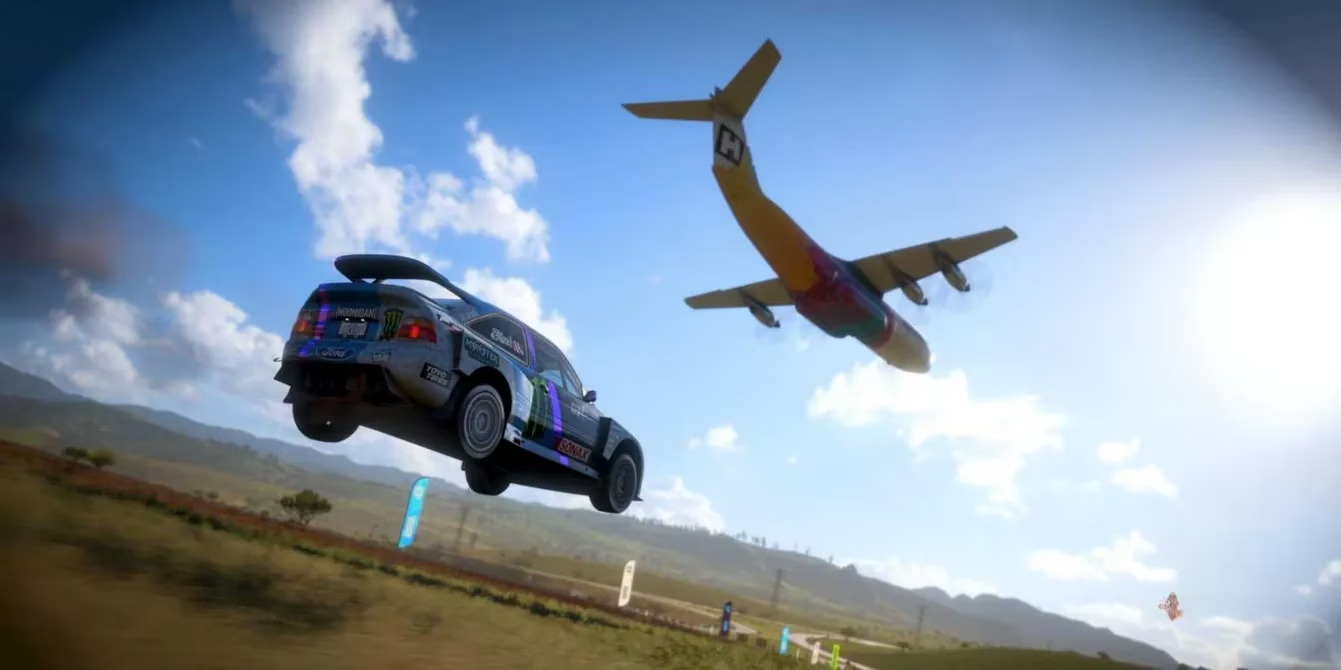
Recent developments suggest that Starfield might be getting a second chance. Bethesda's brief announcement about Update 1.15.222 hinted at future plans for the game, stating that the studio would share "more about the exciting things we have planned for Starfield in the coming months." This comes amid Microsoft's strategy of bringing former Xbox exclusives to PlayStation 5, following successful ports of titles like Hi-Fi Rush and Forza Horizon 5.
The potential PS5 version represents more than just another platform release—it could be Starfield's opportunity to find the audience it deserved from the beginning. PlayStation players who missed the initial launch might approach the game with fresh eyes, unburdened by the expectations that weighed down its Xbox and PC debut. The expanded player base could breathe new life into the community and potentially justify additional content updates that address the original version's shortcomings.
For all its flaws, Starfield's universe remains compelling. The core concept of exploring settled systems while uncovering ancient mysteries continues to hold appeal. The game's visual design, from the sleek interiors of advanced spacecraft to the rugged surfaces of frontier planets, creates a consistent and believable sci-fi setting. The faction system, while underdeveloped in the original release, provides a foundation for richer political storytelling in potential future expansions.
As Bethesda moves forward with The Elder Scrolls 6, the lessons learned from Starfield's mixed reception could prove invaluable. The studio now understands that modern players expect more than just scale—they want depth, cohesion, and innovation. Starfield's ambitious scope demonstrated that Bethesda still dreams big, but its execution revealed the limitations of relying on outdated design principles.
The upcoming months will be crucial for determining Starfield's legacy. Will it be remembered as Bethesda's first major misstep in the modern era, or as a flawed but worthwhile experience that found its footing through post-launch support and multiplatform availability? Only time will tell whether this space opera can achieve the redemption arc that both its developers and dedicated fans hope for.
0 Comments