
Starfield's Shattered Space Map: Small But Mighty And Hand-Crafted To Perfection
Starfield’s Shattered Space DLC excels with hand-crafted maps, making exploration far more rewarding than massive procedural worlds.
When Starfield’s Shattered Space DLC dropped back in 2024, it turned heads for more than just its mysterious story—it completely reimagined how exploration feels in a game that had, let’s face it, leaned a little too hard on procedural generation. Fast forward to 2026, and the expansion is still being hailed as one of Bethesda’s finest map designs, even if its size on paper is practically microscopic compared to the base game. The real kicker? Shattered Space proves that bigger isn’t always better, and it does so with a hand-crafted swagger that’s downright infectious.
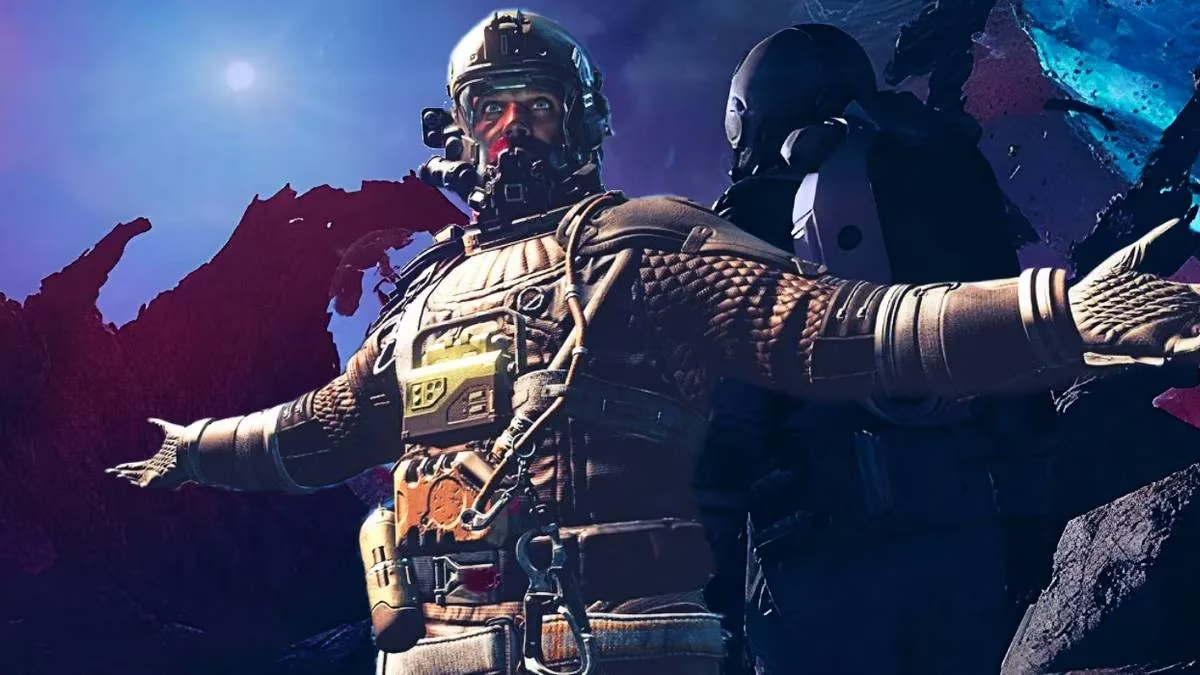
Let’s talk numbers for a hot second. Starfield’s main game boasts nearly 1,700 planets, a jaw-dropping figure that had explorers salivating before launch. But anyone who’s spent more than a few hours wandering those procedurally generated worlds knows the truth: quantity doesn’t equal quality. You’d see the same cookie-cutter labs, the same abandoned outposts, and endless barren landscapes that made the galaxy feel more like a screensaver than a living universe. Shattered Space, on the other hand, focuses almost entirely on a single star system with two planets—one chunky world called Va’ruun’kai and its smaller sibling, plus a handful of moons. If we’re doing the math, that’s less than two thousandths the size of the overall map. On paper, it sounds like a downgrade, but in practice, it’s a total game-changer.
The secret sauce? Every single inch of Va’ruun’kai is hand-crafted. No random algorithms, no soulless repetition. The team at Bethesda meticulously placed 50 distinct points of interest across the planet’s surface, from satellite settlements and ancient archeological sites to—no joke—a Chunks franchise, because apparently even deep-space religious factions need a fast-food fix. Outside the bustling city of Dazra, which serves as your home base with all the merchants and crafting stations you could ever need, exploration feels organic. You’re not just trudging toward a map marker; you’re stumbling upon side quests, discovering eerie natural phenomena, or just soaking in the eerie beauty of the Shattered Cliffs. And thanks to the Rev-8 vehicle, getting around is a breeze, encouraging you to travel by land instead of constantly fast-traveling through loading screens.
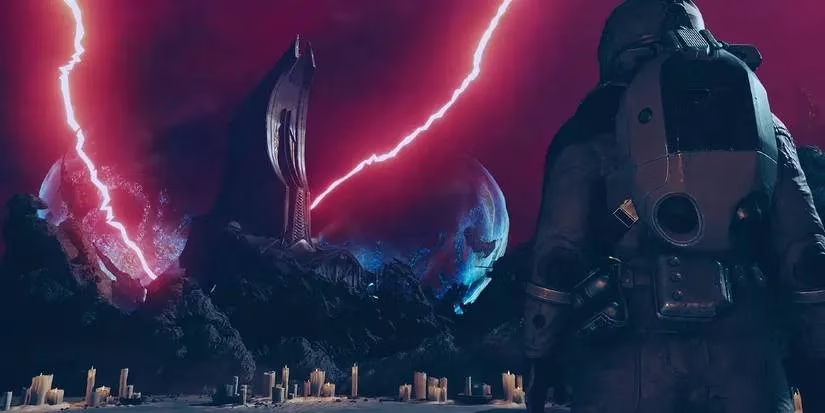
This shift in design philosophy is the real MVP here. Base Starfield often felt like a theme park where the rides were miles apart and the queue was just a long, silent walk. Procedural generation, for all its hype, couldn’t account for player boredom—something human designers instinctively avoid. In Shattered Space, you’re never left on a barren rock with nothing to do; there’s always a new curiosity just over the next ridge. It’s a night-and-day difference that brings back the classic Bethesda magic, where you can get lost for hours simply because the world is full of compelling distractions. In fact, many players report spending more time exploring Va’ruun’kai alone than they ever did on any single planet in the base game. On a surface level, that’s wild, but it makes perfect sense when the environment is this dense with purpose.
To put the DLC’s size in perspective, let’s compare it to other Bethesda heavy hitters. The following table breaks down approximate map areas and points of interest based on community mapping efforts and official data from 2026:
| Expansion / Game | Map Style | Approx. POIs | Hand-Crafted? | Player Time (Avg.) |
|---|---|---|---|---|
| Starfield: Shattered Space | Single planet focus | 50+ | Yes | 20–40 hours |
| Fallout 4: Far Harbor | Island region | 40+ | Yes | 15–25 hours |
| Fallout 4: Nuka-World | Amusement park zone | 30+ | Partially | 12–20 hours |
| The Elder Scrolls V: Dawnguard | Multiple new areas | 50+ | Yes | 15–30 hours |
Shattered Space doesn’t just hold its own—it smashes expectations, offering a chunky slab of content that rivals full-on expansions from Bethesda’s golden era. By file size alone, it’s one of the largest DLCs they’ve ever shipped, and you feel that weight when you’re 25 hours deep, still uncovering fresh narrative threads and hidden caves.
Now, let’s not get it twisted; Shattered Space won’t magically fix the base game’s sprawling emptiness. If you’re hopping back into Starfield after finishing the DLC, those 1,700 planets will still feel like a highlight reel of sameness. But what it does is show what’s possible when Bethesda leans into their strengths: hand-crafted worlds, environmental storytelling, and genuine surprise around every corner. Va’ruun’kai, the homeworld of the enigmatic House Va’ruun, bursts with personality—Dazra’s streets pulse with religious fervor, the ruins whisper of ancient secrets, and the whole place crackles with an atmosphere that’s been missing from the Settled Systems.
So if you’ve been sleeping on Shattered Space since 2024, 2026 is the perfect time to dive in. Whether you’re hunting down new Legendary gear, piecing together House Va’ruun’s tangled history, or just cruising the purple-hued landscape on your Rev-8, this DLC serves up a masterclass in focused map design. It’s hands down one of the best reasons to boot up Starfield again—just don’t be surprised if you end up ignoring the rest of the galaxy altogether. After all, why chase a thousand procedurally generated worlds when one hand-crafted gem can steal the whole show?
0 Comments