
Starfield's Starborn Trademark and Bethesda's Long Game in 2026
Starfield's rocky debut sparked debate, but Bethesda's Shattered Space and Starborn plans hint at a bigger future.
Starfield arrived in September 2023 as Bethesda Game Studios' first original intellectual property in more than 25 years, and the weight of that milestone was impossible to ignore. It was positioned as a system seller for Xbox, a grand space RPG from the studio behind The Elder Scrolls and Fallout, and a project that carried nearly a decade of expectations after Fallout 4. When it finally launched, critics offered mostly solid reviews, but the player base proved far more divided. Exploration, presentation, and plot became flashpoints, and what should have been a victory lap for Bethesda instead became a debate about what modern role-playing games should be. By 2026, nearly three years after launch, that debate has not disappeared. It has simply matured into a different question: can Starfield grow into something greater than its rocky debut?
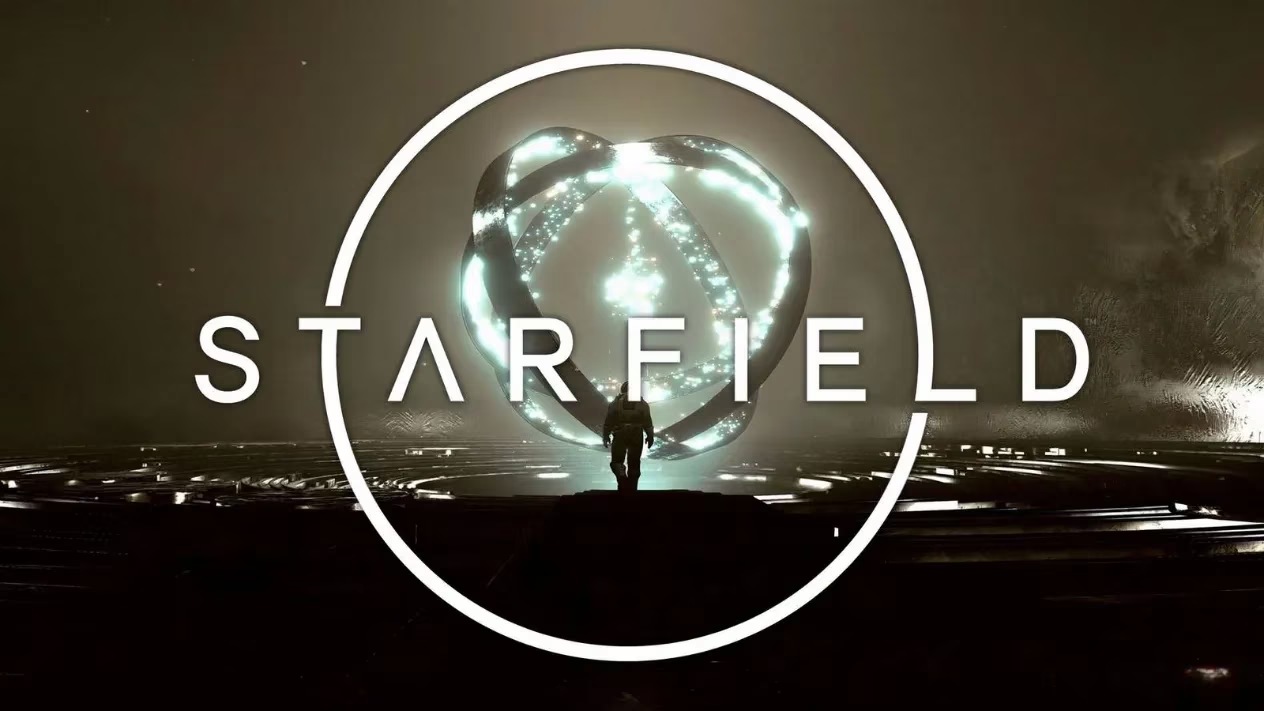
From Hype to Hard Questions
Bethesda did not respond to the mixed reception by walking away. Instead, the studio doubled down on its ambitious space RPG. Consistent content updates followed, and the developer made it clear that Starfield was not a one-and-done release. The game became part of a longer support strategy, one that treated the universe as a platform rather than a single story. That approach matters in 2026, because the industry now expects major RPGs to evolve through patches, expansions, and community tools long after launch.
Still, the central criticism has never fully vanished. Some players wanted deeper exploration, more seamless travel, and a narrative that felt as urgent as Bethesda's earlier worlds. Others found the scale impressive but the emotional connection thinner than expected. Was Starfield a failure, or was it simply crushed by impossible expectations? The answer depends on who is asked, and that ambiguity has kept the conversation alive.
Shattered Space and the Annual Expansion Plan
The first major story expansion, Shattered Space, was set to arrive later in 2024. Bethesda shared relatively little about the paid DLC before release, but its existence signaled that the studio intended to expand Starfield's lore in meaningful chunks. More importantly, Bethesda Game Studios director Todd Howard spoke in June 2024 about a Year 2 roadmap for the game. In an interview with MrMattyPlays, Howard explained that Bethesda wanted to release a new Starfield expansion annually for as long as possible. He declined to detail every update, but the message was clear: the studio was thinking in years, not months.
That philosophy explains why the Starborn trademark continues to fascinate fans in 2026. If Bethesda truly intends to support Starfield with annual story drops, then a second expansion after Shattered Space was always likely. The only question was what it would be called, and the trademark suggested an answer.
The Starborn Trademark Mystery
On July 12, 2024, Zenimax Media, the parent company of Bethesda Game Studios, filed a trademark for the name Starborn. Nothing in the registration explicitly confirmed a connection to Starfield, but the link was difficult to dismiss. Starborn is a term used directly in the game, referring to an enigmatic faction tied to the main story. For observant fans on social media, the filing looked like a clue about the next expansion after Shattered Space.
What else could the trademark be for? A comic, a novel, a television project, or merchandise are all possible. Publishers often register names defensively, protecting phrases that might become valuable later. Yet the timing and wording made a Starfield expansion the most tempting theory. If Bethesda wanted to follow its annual expansion plan, then Starborn was a natural title for the next chapter.
What a Starborn Expansion Could Reveal
In Starfield, the Starborn serve as both an antagonistic force and the catalyst behind the main narrative. They are mysterious, powerful, and deeply connected to the game's central questions about identity, repetition, and choice. A dedicated expansion could finally pull back the curtain on their origins, motives, and internal conflicts. It could also give players new powers, new regions, and difficult moral decisions that reshape how the main story is understood.
There is another intriguing possibility. Bethesda could treat Starborn as a spiritual callback to Skyrim's Dragonborn expansion, which featured Miraak, the First Dragonborn, as a primary antagonist. That DLC expanded Skyrim's mythology while delivering a memorable villain and a strange new realm. A Starborn expansion could do something similar for Starfield: introduce a rival, explore a forgotten corner of the universe, and make the player question what it truly means to become Starborn.
| Possible Focus | Why It Fits Starfield |
|---|---|
| Deeper Starborn lore | The faction is central to the main story but still mysterious |
| New powers and abilities | The game already uses supernatural and cosmic themes |
| A Skyrim-style antagonist | Dragonborn proved this formula works for Bethesda |
| New regions or realities | Starborn travel and repetition open endless possibilities |
| Moral choices | The main story already asks what players are willing to sacrifice |
Bethesda's Broader Strategy
Starfield's future is not only about expansions. It is also about updates, mod support, Creation Club content, and the long-tail power of Xbox Game Pass. Bethesda has learned that a divisive launch does not have to be the final word. Games such as No Man's Sky and Cyberpunk 2077 eventually rebuilt their reputations through years of work. Could Starfield follow a similar path? That is the hope behind the annual expansion plan, and it is why the Starborn trademark remains such a persistent topic.
As 2026 unfolds, the exact status of a Starborn expansion is still a subject of speculation rather than a fully confirmed reveal. Bethesda has not explained every piece of its post-Shattered Space roadmap, and the studio prefers to announce details on its own schedule. Even the 2024 Gamescom appearance, where Microsoft confirmed Starfield would be present, became part of the rumor cycle. Fans hoped for a teaser, and when no clear answer arrived, the trademark only grew more intriguing.
The Waiting Game
So what should fans expect? If the Starborn trademark is connected to a future expansion, then Bethesda may be preparing a story that dives directly into the game's most enigmatic faction. If it is not, then the filing may simply be a defensive move. Either way, Starfield remains a living project. Its universe is too large, its lore too open-ended, and its community too invested for Bethesda to abandon it quietly.
The real question is not whether Starfield will receive more content, but whether that content can change how the game is remembered. A strong Starborn expansion could deepen the main story, answer long-standing mysteries, and give players a reason to return. A weak one would only reinforce the criticisms that have followed the game since 2023. For Bethesda, the stakes are clear. In 2026, Starfield is no longer just a launch. It is a test of whether a controversial RPG can evolve into a beloved one.
0 Comments