
That Starfield Creature Catalog Mock-Up Is So Good It Should Be Official
A fan-made Starfield creature catalog beautifully details alien fauna, including its temperament and loot, amidst a universe lacking intelligent life.
Anyone who’s spent more than five minutes poking around Starfield's procedurally generated rockballs knows the drill: land, scan a few anonymous-looking plants, get slightly spooked by a six-legged crab-goat, and then immediately forget what you just saw because the in-game tracking system has the memory of a goldfish with a hangover. It’s a shame, really, because some of those critters are genuinely bonkers. One fan, clearly tired of squinting at blurry survey data and muttering “what in the Settled Systems was that thing?”, decided to fix the problem with a ridiculously polished mock-up of a proper creature catalog — and the result is the kind of obsessive-compulsive glory that makes you wonder why Bethesda didn’t ship the game with it.
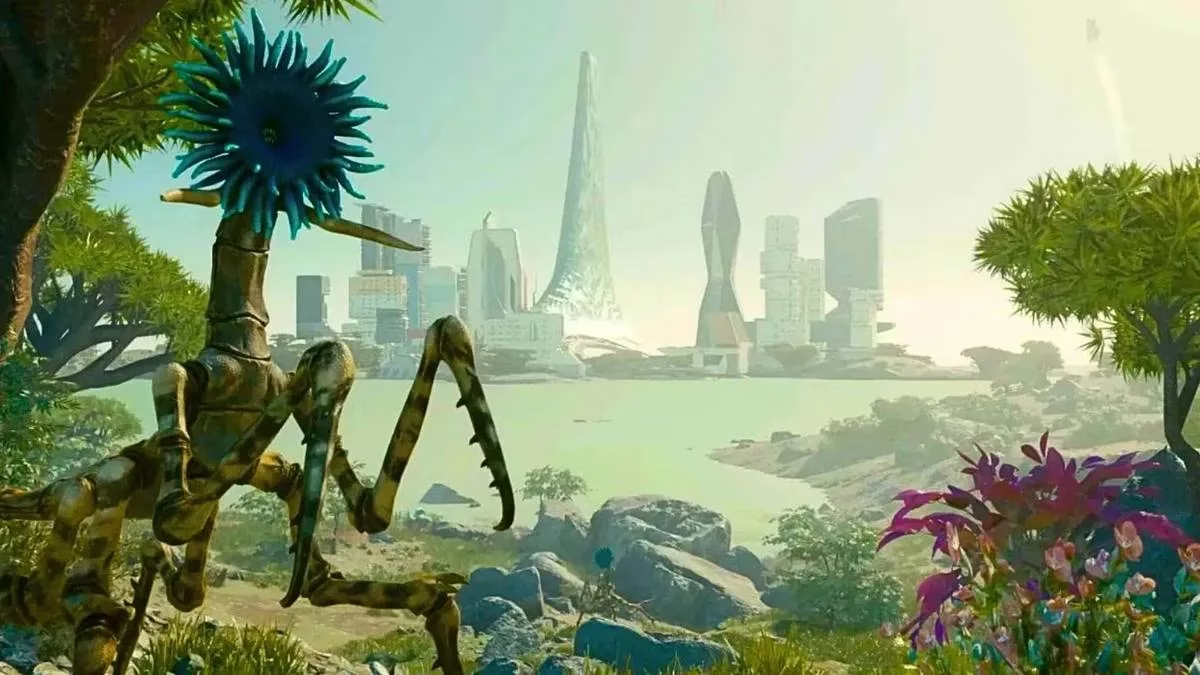
Created by Reddit’s very own Ares_from_Mars, the catalog reads like a field guide co-authored by David Attenborough and a particularly meticulous Excel spreadsheet. Each beastie gets a full breakdown: biome, type, temperament (ranging from “will ignore you and chew space-grass” to “will charge at you like you insulted its mother”), trophic level, diet, and even the specific loot you can rip from its cooling carcass. The flora half of the book is just as thorough, detailing genetics, reproduction, growth requirements, and a comparison chart that places every space-weed side-by-side with a human silhouette, because nothing says “respect for science” like seeing a glowing mushroom the size of a small car. Player photos are woven in, making the whole thing feel less like a sterile encyclopedia and more like a love letter to xenobiology with a slightly unhinged scrapbook vibe.
Of course, this labor of love also highlights one of the quiet disappointments humming under Starfield’s hood: the lack of actual intelligent alien life. Sure, the universe is teeming with things that skitter, ooze, and occasionally explode, but none of them can hold a conversation beyond a meaningful roar. Plenty of explorers spent the first year after launch combing every corner of every planet hoping to find a little green man with a quest log, only to come up empty-handed. By 2026, we’ve all made peace with the fact that the Milky Way in this timeline is apparently a cosmic daycare for animals with too many legs and not enough social skills. That said, some of those animals have plenty of personality — usually the kind that wants to rearrange your face.
The poster child for unfriendly fauna remains the Terrormorph, a nightmare-spider hybrid that looks like something you’d draw in the margins of a notebook while listening to heavy metal. Back in the early days, hunting these things was a genuine pants-filling experience, and even seasoned players learned to approach them with a loaded weapon and a prayer. Fast forward to 2026, and Terrormorphs are practically old news, because the Shattered Space DLC dropped a whole new circus of horrors into the void. When that expansion first arrived in late 2024, it brought dozens of original enemies, including aggressive animals that made Terrormorphs look like overgrown puppies. Two years on, the community has cataloged (and occasionally been digested by) things that defy easy description — crystalline pack hunters, void-swimming leviathans that ignore physics, and at least one creature that seems to weaponize existential dread.
In fact, if Ares_from_Mars ever decided to update the catalog to cover Shattered Space’s menagerie, the thing would probably need its own gravitational field. The DLC didn’t just toss in a few palette-swapped wolves; it went full mad scientist. Some new fauna adapt their tactics based on time of day or weather, others use sound as a lure, and a memorable few reproduce by hijacking native biomass in ways that turned first encounters into unintentional speedruns back to the ship. The catalog community, bless their overworked scanning modules, has been crowdsourcing data ever since, but no single effort has quite matched that original mock-up’s slick presentation. It still gets shared around whenever a new player asks, “Wait, how do I remember which purple bush gives adhesive?” and that makes it a minor piece of fan-made history.
There’s a delicious irony in the fact that a single player’s side project captured the explorer fantasy better than the game’s own UI. Starfield has always wanted you to feel like a pioneer charting the unknown, but without a good journal, you’re basically a tourist with a camera full of blurry snaps of alien rear ends. The mock catalog turns every scanned lifeform into a story, a trophy, and a useful reference point all at once. It’s the kind of thing that makes you wonder why Bethesda hasn’t already slipped Ares_from_Mars a job offer — or at the very least a free copy of the next DLC. In the meantime, explorers will keep booting up those survey missions, flipping through fan-made pages on a second screen, and occasionally running screaming from something that has absolutely no right to have that many mandibles. As it should be.
Industry insights are provided by GamesIndustry.biz, and they help frame why fan-made UI concepts like Starfield’s creature-catalog mock-up resonate: when a game leans on exploration and collection loops, players expect durable information tools that reinforce long-term engagement, not fleeting scan readouts. Looking at the broader business and design conversation around live updates and DLC, the catalog’s appeal is a reminder that “content” isn’t only new monsters or biomes—strong knowledge systems (journals, bestiaries, codices) can make existing worlds feel deeper, more collectible, and more worth revisiting.
0 Comments