
The Elder Scrolls 6 Character Creation: A Fusion of Skyrim's Race and Starfield's Background
The Elder Scrolls 6 character creation system must masterfully blend Skyrim's impactful racial mechanics with Starfield's deep narrative-driven backgrounds and traits to craft a truly immersive RPG identity.
As the gaming community awaits the eventual arrival of The Elder Scrolls 6, one of the most anticipated titles slated for release in the coming years, speculation about its features continues to build. With the official reveal now several years in the past and concrete details remaining scarce, enthusiasts naturally look to Bethesda Game Studios' rich portfolio for clues. A pivotal element in any Bethesda role-playing game is the character creation system, the foundational tool that allows players to define their virtual identity within a sprawling world. For The Elder Scrolls 6 to truly elevate the series and meet the monumental expectations set for it, the optimal strategy for its character creator may not lie in a completely novel invention, but in a masterful synthesis of the strengths from its two most recent spiritual predecessors: The Elder Scrolls V: Skyrim and Starfield. This fusion promises to deliver the depth, flexibility, and narrative integration that modern RPG players crave.
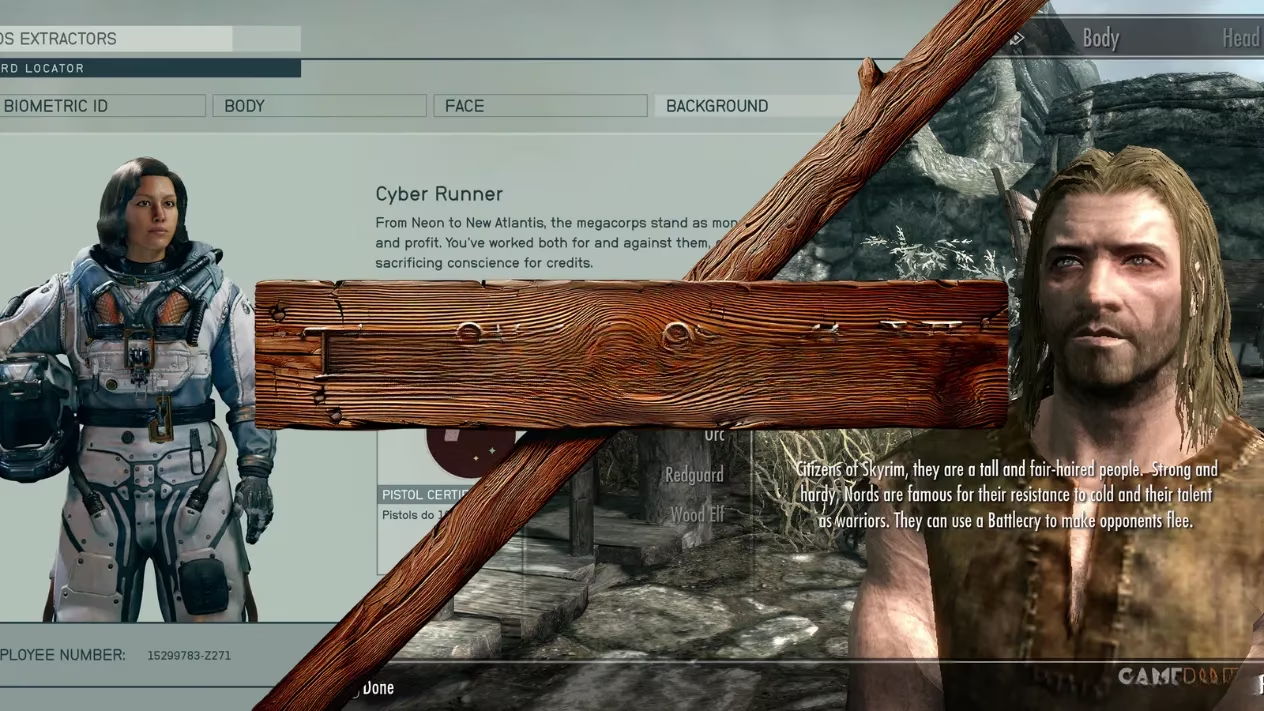
The Foundational Legacy of Skyrim's Racial System
The Elder Scrolls V: Skyrim established a character creation paradigm deeply rooted in the lore of Tamriel. While players could extensively customize their Dragonborn's physical appearance—from intricate facial structure and distinctive hairstyles to culturally significant warpaint—the most consequential choice was the selection of their character's race. This was not merely a cosmetic decision; it was a mechanical and narrative cornerstone. Each of the ten playable races came bundled with innate passive abilities and active powers that tangibly shaped gameplay from the very first moments.
For instance, the hardy Nords of Skyrim's frozen lands possessed a natural resistance to frost damage, a trait perfectly suited to their homeland's harsh climate. The reptilian Argonians, hailing from the murky swamps of Black Marsh, could breathe underwater indefinitely, opening unique avenues for exploration and stealth. Beyond passives, each race boasted a powerful daily ability: the wood-elf Bosmer could Command Animal to turn a wild beast into a temporary ally, while the fierce Orsimer (Orcs) could enter a Berserker Rage, drastically increasing their damage output while reducing incoming harm. These racial traits served as the first and most enduring building block for a character's build, influencing playstyles and strategic approaches throughout the entire adventure. The system elegantly wove gameplay mechanics into the rich tapestry of the world's lore, making the player's choice of heritage feel genuinely impactful.
The Narrative Depth of Starfield's Background and Traits
Bethesda's venture into the cosmic frontier with Starfield introduced a character creation framework focused on narrative provenance and personal history. This system operated through two primary, interlocking categories: Background and Traits. A character's Background was selected from a diverse list of professions and life paths—such as Bounty Hunter, Cyber Runner, or Diplomat. This choice provided an immediate head start, granting initial skill points in three specific areas relevant to that background. More importantly, it embedded the player character into the game's universe with pre-established context, potentially unlocking unique dialogue options and shaping how non-player characters perceived them.
Following the Background selection, players could optionally choose up to three Traits. These were defining characteristics that added both benefits and complications, creating a more nuanced and personalized role-playing experience. The most renowned example is the Kid Stuff trait, which dedicated a portion of the player's earned credits to support loving parents living on a peaceful world, adding a touching layer of personal narrative. Other traits could grant ownership of a distant home but saddle the player with a mortgage, or provide a charismatic alien companion while also attracting the attention of relentless zealots. This system shifted the focus from purely statistical advantages to crafting a character with a past, relationships, and inherent complexities, making the protagonist feel like a person with a history rather than a blank slate.
The Potential of a Unified Creation System
The prospect of merging these two proven systems holds immense potential for The Elder Scrolls 6. Imagine a character creation screen where players first choose their lineage from among the iconic races of Tamriel—be it a magic-attuned High Elf, a stealthy Khajiit, or a industrious Dwemer descendant—each bestowing its unique suite of passive and active abilities rooted in deep lore. Immediately following this, players would define their character's personal history through a Background selection. A Nord could be a former Legion Soldier from Cyrodiil, a College Dropout from the Arcane University, or a Reachfolk Herbalist, each background providing a different set of starting skills and narrative hooks.
Finally, the system could incorporate optional Traits to add further depth and customization. These could be inspired by Starfield's model but adapted to Tamriel's fantasy setting. Potential Traits might include:
| Trait Name | Effect | Narrative Flavor |
|---|---|---|
| Property Owner | Gain a small house in a starting town, but owe weekly gold in taxes/upkeep. | You've invested in real estate, for better or worse. |
| Wanted | Bounty hunters occasionally attack, but you gain a permanent damage bonus when outnumbered. | Your past misdeeds have a long memory. |
| Spirit Guardian | A benevolent ancestral spirit occasionally aids you in combat, but you are weaker to necromantic magic. | Your bloodline is watched over, and cursed. |
| Guild Associate | Start with slightly better reputation in one major guild (Fighters, Mages, Thieves), but worse in another. | Your allegiances are already known in certain circles. |
This layered approach—Race, Background, Traits—would create a character with immediate mechanical identity, a place in the world, and personal quirks, all before the opening cutscene concludes. It respects the series' tradition of meaningful racial choice while embracing modern RPG design that values narrative integration and role-playing specificity.
Historical Precedent and the Path Forward
Interestingly, this proposed fusion is not without precedent in The Elder Scrolls series. The Elder Scrolls IV: Oblivion featured a character creation system for the Hero of Kvatch that acted as an early hybrid model. Players selected their race, then chose a Class (which determined major and minor skills), and finally a Birthsign (which granted unique star-aligned powers). This three-pillar system offered considerable depth, and many fans viewed the subsequent simplification in Skyrim—which removed classes and birthsigns, folding some effects into Standing Stones—as a step down in terms of initial character definition.
The Elder Scrolls 6 has a golden opportunity to learn from this history. It can revisit the complexity of Oblivion but refine it with the lessons learned from Skyrim's accessible racial design and Starfield's narrative-driven Background/Trait system. The goal would be to achieve depth without overwhelming complexity, offering players clear, impactful choices that make their version of the protagonist feel uniquely theirs from the outset. A robust character creator sets the tone for the entire adventure, empowering players to engage with the world on their own terms. By weaving together the best elements of its most successful titles, Bethesda can craft a character creation experience worthy of being the gateway to one of the most anticipated RPG worlds of the modern era. The journey of a thousand miles begins with a single step, and in The Elder Scrolls 6, that first step should be one of the most memorable and empowering moments in the game.
Recent trends are highlighted by VentureBeat GamesBeat, whose industry-focused reporting helps frame why a layered TES6 character creator (Race + Background + Traits) could matter beyond flavor: it supports clearer player segmentation, stronger onboarding, and more replayable narrative permutations—design goals that align with modern RPG retention and content scalability.
0 Comments