
The Galactic Evolution of No Man's Sky: Why Hello Games Should Embrace Cosmic Anarchy in 2026
Explore No Man's Sky's 2026 evolution, a universe of unparalleled freedom, and consider the revolutionary potential of introducing structured chaos with a pirate faction like the 'Void Corsairs' for deepened roleplay and exclusive gameplay loops.
As we sail through 2026, the universe of No Man's Sky has undergone a metamorphosis as dramatic and improbable as a cosmic tadpole evolving into a star-dwelling leviathan. From the cratered, desolate landscape of its 2016 debut, Hello Games has, update by monumental update, sculpted a living, breathing galaxy that has not only redeemed its name but has established itself as a titan of the sci-fi genre. While other stars have flickered in the firmament, No Man's Sky's light has only grown more brilliant, its future stretching out like the infinite arms of a spiral nebula. Yet, in this era of unparalleled freedom, a tantalizing whisper of controlled chaos beckons, a lesson perhaps learned from the turbulent orbit of a fellow traveler: Bethesda's Starfield.
The Stark Contrast: A Universe of Choice vs. A Galaxy of Silence
For nearly two years, Starfield has navigated a tricky asteroid field of player critique, often accused of offering vast, beautiful emptiness—worlds as hollow as a discarded exoskeleton. Its Crimson Fleet, a rogue's gallery of space pirates, stands as a rare, glittering jewel in its crown, a faction offering tangible perks like access to the black market haven, The Key. Meanwhile, Bethesda's ongoing radio silence on the game's trajectory has left its community floating in a disquieting void. This silence stands in stark, almost deafening, contrast to the vibrant, constant dialogue Hello Games maintains with its explorers.
The Case for Cosmic Anarchy: Injecting Factional Flavor
No Man's Sky's core tenet is, and always has been, unadulterated freedom. There is no morality system governing your journey; you are the arbiter of your own cosmic destiny. You can be a peaceful botanist cataloging fungal wonders or a marauder plundering freighters with the cold efficiency of a supernova. This sandbox philosophy is its greatest strength, but in 2026, it could be the perfect foundation upon which to build something more structured without compromising that spirit.
Why a Pirate Faction Could Be Revolutionary:
-
Deepened Roleplay: Currently, piracy is an action, not an identity. Introducing a faction like the "Void Corsairs" or "Neutron Marauders" would provide a tangible community and narrative framework for outlaw players. It would transform isolated acts of banditry into a career with ranks, lore, and goals.
-
Exclusive Gameplay Loops: Taking a page from the Crimson Fleet's playbook, such a faction could grant access to:
- Hidden Stations: Lawless hubs orbiting in asteroid shadows or within nebular clouds, serving as centers for illicit trade, unique missions, and faction-specific vendors.
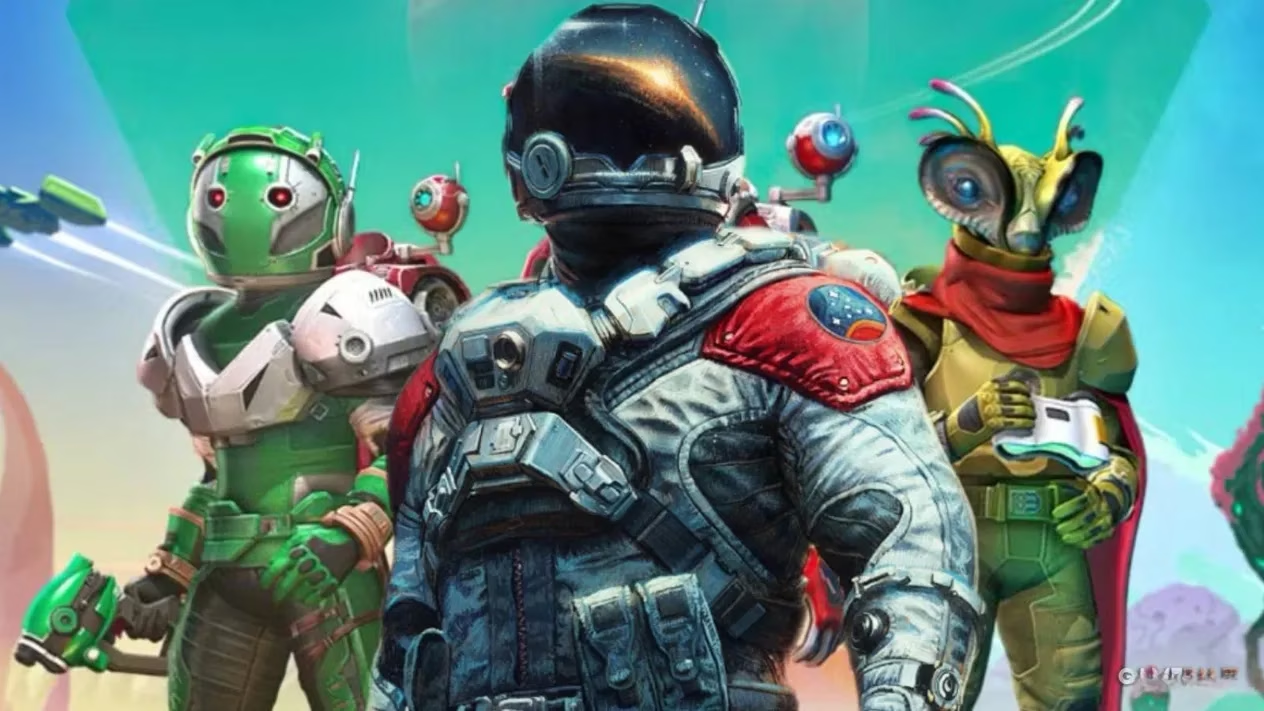
-
Black Market Tech: Ships, multi-tools, and exosuit upgrades unavailable through normal channels, perhaps with trade-offs like higher damage but conspicuous scanner signatures.
-
Faction Wars: Dynamic conflicts with Sentinel forces or a hypothetical "Galactic Defense Initiative," creating emergent, large-scale battles over resource-rich systems.
The Engine of Wonder: Procedural Generation's Greatest Triumph
Where Starfield's worlds can sometimes feel like beautifully rendered dioramas, No Man's Sky's procedural engine is a tireless, chaotic artist. It doesn't just create planets; it births ecosystems. A single update can scatter across the universe:
| Feature | No Man's Sky (2026) | Typical Competitor |
|---|---|---|
| Planetary Diversity | 🌍🌵❄️🔥🌊 (Extreme Biome Mix) | 🌍 / ❄️ / 🔥 (Often Singular) |
| Flora & Fauna | Procedurally generated, often surreal | Hand-crafted, more realistic |
| Exploration Incentive | Constant, update-driven novelty | Often narrative-dependent |
This boundless diversity is the game's bedrock. Adding a complex faction system on top of this would be like grafting a sentient, talking orchid onto a ancient, wild redwood—it could create something spectacularly new and unexpected, or it could clash. The risk is that structured faction goals might feel like a checklist, contradicting the game's ethos of aimless wonder.
The 2026 Verdict: Evolution, Not Revolution
Hello Games faces a fascinating design puzzle. The community has thrived for a decade without prescribed morality. Introducing rigid "good vs. evil" perks could feel like forcing a square peg into a black hole. However, the compromise may lie in optional, depth-focused content.
Imagine not a morality system, but a "Reputation Web." Your actions with one group (e.g., pirates) could open doors with them while slowly closing them with others (e.g., peaceful guilds or the Sentinels). These wouldn't be moral judgments, but practical consequences—a natural extension of the game's existing economy and conflict systems. The freedom to ignore this web entirely would remain sacrosanct.
Ultimately, No Man's Sky in 2026 is a testament to resilient creativity, a universe that has grown like a galactic coral reef—complex, interconnected, and full of surprising life. While Starfield's future remains an unanswered transmission, No Man's Sky's path is illuminated by the light of a thousand suns. Borrowing the compelling idea of faction depth from others, while filtering it through its own unique lens of player agency, could be the next great leap. It doesn't need to become something else; it just needs to continue fearlessly becoming more of itself, even if that self occasionally enjoys a bit of profitable chaos among the stars. 😎🚀
0 Comments