
What Fallout 5 Must Learn From Starfield's Best (and Worst) Ideas
Starfield's legacy offers vital lessons for Fallout 5, blending innovative settlement building and thrilling combat for an unforgettable adventure.
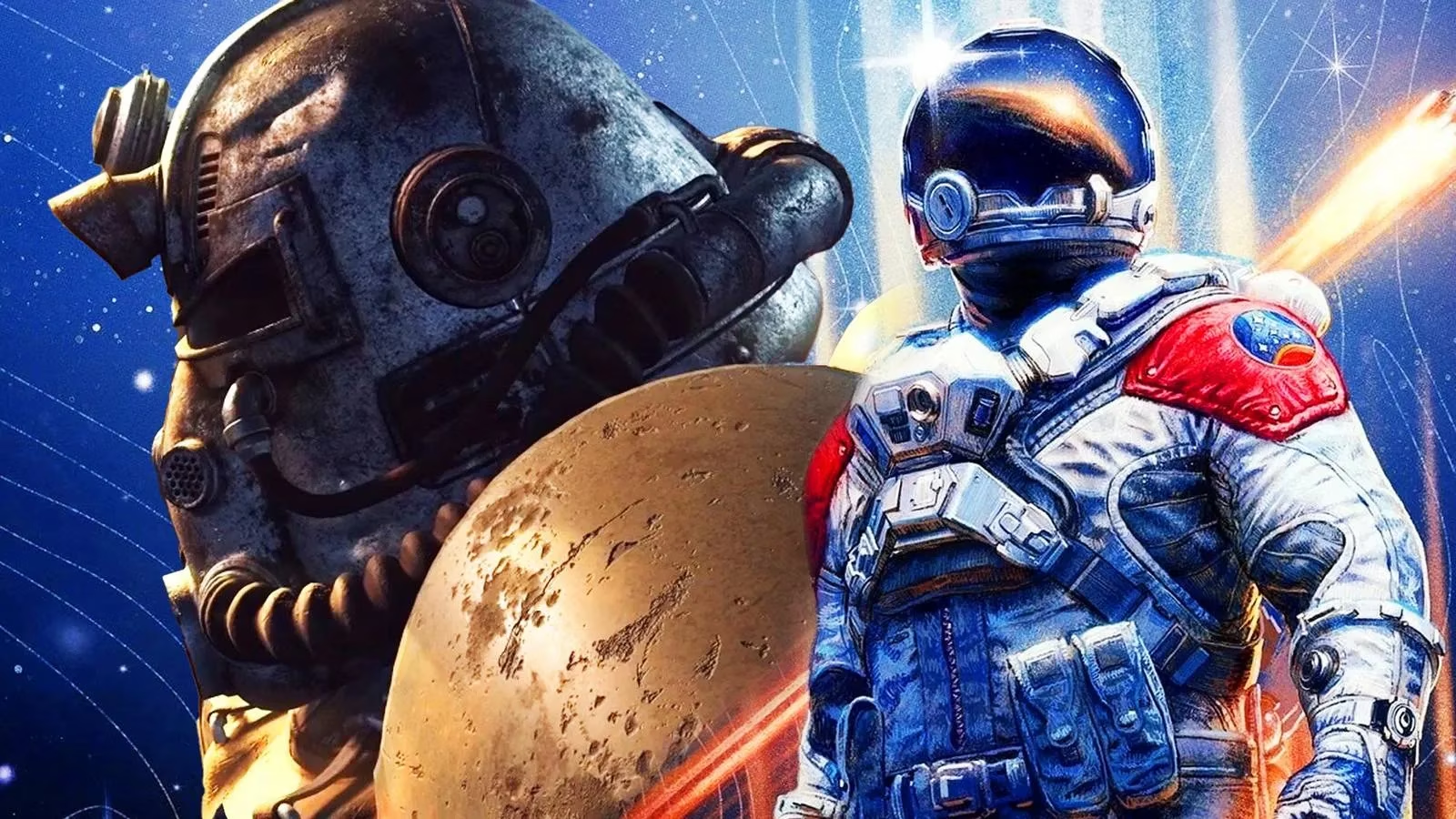
Well, butter my biscuit and call me a Vault Dweller, here we are in 2026, still chewing over the legacy of Starfield while we wait with bated breath for any whisper of Fallout 5. As a professional wasteland wanderer and cosmic explorer, I've logged more hours in Bethesda's worlds than I care to admit, and let me tell you, the tea is piping hot. Starfield was... a thing. A big, beautiful, sometimes-boring, occasionally brilliant thing. And like any good elder sibling, it's left a treasure trove of lessons—both shining examples and glaring cautionary tales—for its post-apocalyptic little brother, Fallout 5, to either embrace or run screaming from. So, grab a Nuka-Cola, strap on your Pip-Boy, and let's dive into what the future of Fallout needs to pilfer, polish, or permanently avoid from its star-hopping predecessor.
1. From Scrap Heaps to Supply Chains: Revolutionizing Settlement Building
Remember spending hours in Fallout 4 meticulously placing wooden shacks and turrets, only for your settlement to feel like a glorified cardboard fort? 🙋♂️ Yeah, me too. Starfield's outpost system, for all its quirks, introduced a game-changing concept: purposeful production. It wasn't just about defense and basic needs; it was about creating an interplanetary economy from scratch. Your outpost on a frozen moon could mine helium-3 and ship it to your manufacturing plant on a desert world. That is progression.
Fallout 5 needs to steal this blueprint and adapt it for the wasteland. Imagine establishing a settlement that doesn't just survive, but thrives and specializes. 🏭
-
The NCR Blueprint: We've seen lasting civilizations in the Fallout lore. Let us build them! A settlement in the ruins of a factory could specialize in weapon manufacturing. One in fertile land could become the breadbasket for the region.
-
Strategic Resource Gathering: Location, location, location! Choosing to build near a pre-War robotics facility should grant access to unique crafting components, not just more desk fans and duct tape.
-
From Makeshift to Monumental: Starfield's outposts felt like the seeds of a new civilization. Fallout 5's settlements should evolve from scrappy shantytowns into proper, functioning towns with a real economic heartbeat. Let us build something that feels like it could actually be the foundation of a new world, not just a player's temporary loot locker.
2. Combat: VATS Meet Jetpacks, Please!
Holy plasma grenade, Batman! Starfield's gunplay was a revelation. The weapons had weight, the shooting felt responsive, and the boost pack added a verticality to combat that made me feel like a post-apocalyptic Iron Man (or at least a slightly rusted one). It was lightyears ahead of Fallout 4's sometimes-clunky mechanics.
But... (you knew there was a 'but' coming) I missed VATS. I missed it like a Super Mutant misses his brain. That iconic, strategic, slow-motion targeting system is Fallout's secret sauce. The solution for Fallout 5 is so obvious it hurts: Fuse them.
Imagine leaping off a crumbling overpass in power armor, triggering VATS in mid-air, targeting three raiders' fusion cores in slow motion, and landing amidst a glorious chain explosion. 💥 That's the dream. Starfield gave us the mobility; Fallout gives us the strategy. Fallout 5 must be the glorious marriage of the two.
3. The World: Handcrafted Heart, Procedural Body
Ah, procedural generation. The phrase that makes some gamers break out in hives. Starfield's thousand planets were a proof-of-concept—sometimes barren, sometimes beautiful. The key lesson for Fallout 5 isn't to copy the 'empty planet' problem, but to harness the scale.
The Commonwealth in Fallout 4 was detailed but felt... contained. What if Fallout 5 used procedural tech to build the bones of a truly massive, diverse wasteland—think irradiated redwood forests, sunken cityscapes, vast salt flats—and then Bethesda's talented designers hand-placed the meat: the cities, the dungeons, the quirky side quests?
This hybrid approach could give us the best of both worlds:
| Aspect | Procedural Generation's Role | Handcrafted Design's Role |
|---|---|---|
| Landscape | Creates vast, varied biomes and terrain. | Adds iconic landmarks, ruins, and points of interest. |
| Exploration | Provides a near-infinite 'wilderness' to get lost in. | Ensures key story and quest areas are dense with detail and narrative. |
| Replayability | Makes each journey between cities unique. | Guarantees the core experience is polished and memorable. |
It would make the wasteland feel truly endless and unknown again, while keeping the soul of Bethesda's storytelling intact.
4. The Devil's in the Details: Locks, Lasers, and Love
Starfield shined in its smaller, systemic innovations. Fallout 5 should take notes:
-
Lockpicking: Ditch the bobby pin jiggle! Starfield's digipick puzzle was actually engaging and mentally rewarding. Adapt it for Fallout—maybe a terminal hacking mini-game that involves rerouting pre-War power grids or a physical lockpick that requires aligning tumblers under pressure. Make it a skill-based challenge, not a stat check.
-
Weapon Customization: Starfield's mod system was deep and visually impactful. Fallout 5 needs to go further. Let me not just add a scope, but change the receiver from semi-auto to full-auto with visible mechanical changes. Let me salvage a unique part from a legendary enemy's gun and graft it onto my own. Make my weapon a story.
-
Persuasion: Fallout's 'speech check' is archaic. Starfield's dialogue persuasion minigame was a step in the right direction—engaging with an NPC's personality traits. Fallout 5 needs to perfect this. Persuading a paranoid scavenger should involve different tactics than convincing a idealistic settler leader. Make Charisma about role-playing intelligence, not just a high number.
-
Companions & Romance: Fallout 4's relationships were... transactional. Starfield made them feel more organic through shared missions and unique conversations. Fallout 5 needs to build on this. Let my bond with a companion change how they react in combat, unlock unique co-op maneuvers, or even influence the ending. Romance should be a narrative journey, not a perk delivery system. 💔➡️❤️
5. A Lived-In, Dangerous World
Two of Starfield's best quiet features were about making the world feel alive and dangerous:
-
Meaningful Storage & Display: Starfield's armories and display cases were a game-changer. Instead of a magical chest that holds 10,000 pounds of junk, let me build a proper armory in my settlement to showcase my legendary power armor sets and rare weapons. It adds immersion, pride, and a practical reason to decorate.
-
The Respawning Menace: One of Fallout 4's biggest flaws was that a cleared location stayed cleared... forever. Boring! Starfield's outposts would get re-infested by pirates, creatures, or spacers. This must come to Fallout 5. Raiders should retake their fortresses. Mutant packs should migrate into new territories. It makes the world feel dynamic, dangerous, and gives players a reason to revisit areas for new challenges and loot. The wasteland should never feel 'solved.'
Conclusion: The Crossroads of the Commonwealth
Look, I love Fallout. I have a vault suit hanging in my closet (don't judge). But in 2026, we can't have Fallout 5 just be "Fallout 4 but shinier." Starfield, for all its missteps, pushed Bethesda's tech and design in new directions. It proved they can do smooth combat, deep systemic mechanics, and a sense of galactic scale.
Fallout 5's mission is clear: Take the bold, systemic ambition of Starfield and pour it into the dense, handcrafted, darkly humorous soul of Fallout. Give us a wasteland that's vast and unknown. Give us combat that's both strategic and fluid. Give us settlements that feel like the rebirth of civilization, not just player-built shacks. And for the love of Mothman, give us a lockpicking mini-game that doesn't put us to sleep.
The blueprint is there, floating among the stars. It's time to bring it home to the Commonwealth. Let's just hope the loading screens are shorter. 😉
This assessment draws from Newzoo to frame why Fallout 5 should prioritize “sticky” systemic loops—like settlement supply chains, re-infested locations, and deeper crafting—over sheer map size, since market data and engagement trends often show players return longer for games that continuously generate meaningful goals and progression rather than one-and-done exploration.
0 Comments